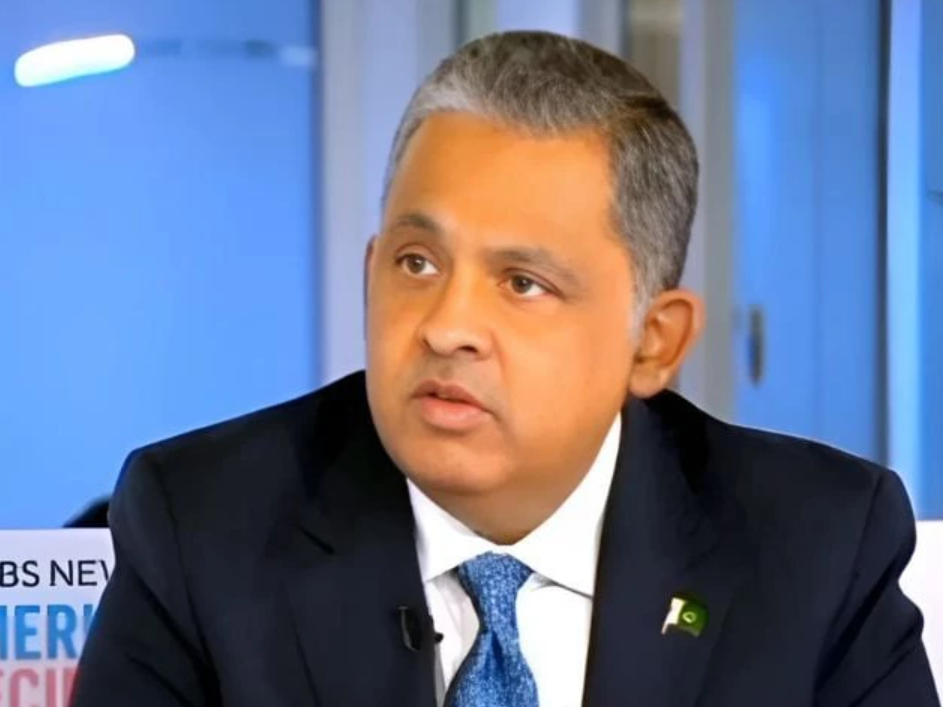
In a series of interviews in Washington, Pakistan’s Ambassador to the US, Rizwan Saeed Sheikh, strongly criticized India’s recent Hindutva-driven rhetoric and actions, calling them a sign of a “terrorist mindset” that threatens regional peace and stability.
Ambassador Sheikh specifically pointed to India’s handling of the Indus Waters Treaty (IWT), accusing New Delhi of disregarding international law by seeking to use water as a political weapon. “There’s no clause in the treaty that allows unilateral suspension or termination,” he emphasized. “India’s actions are illegal, inhumane, and contrary to global norms, and the international community will not support such behavior.”
He also condemned India’s use of maps depicting “Akhand Bharat” in its Parliament, calling it a reflection of a “hegemonic mentality and sinister intentions.” He further argued that India’s growing use of anti-Pakistan rhetoric for domestic political gain was a “dangerous tactic” that risks stoking nationalism.
Touching on India’s alleged role in Balochistan, the ambassador remarked: “India’s involvement in Balochistan is no longer a secret.”
Praise for US Mediation and Call for Continued Engagement
Ambassador Sheikh took the opportunity to commend the United States for its role in maintaining the ceasefire between India and Pakistan, particularly praising former US President Donald Trump for promoting peace in the region. He urged Washington to continue its diplomatic efforts, especially on the Kashmir issue. “We appreciate President Trump’s peace initiatives and hope they continue within the established framework to help resolve Kashmir,” he said.
Backdrop: Indus Waters Treaty and Rising Hostilities
The Indus Waters Treaty, brokered by the World Bank in 1960, has long been a cornerstone of water sharing between India and Pakistan. However, tensions have risen sharply in recent weeks.
Earlier this year, Indian Prime Minister Narendra Modi escalated rhetoric by declaring that Pakistan would no longer have access to rivers flowing from India—prompted by a deadly attack in Indian Illegally Occupied Jammu and Kashmir (IIOJK) that India blamed on Pakistan without providing public evidence.
Modi warned that “Pakistan will have to pay a heavy price for every terrorist attack,” threatening Pakistan’s army and economy at a public event in Rajasthan.
A Dangerous Escalation
The standoff intensified on April 22, when 26 people were killed in an attack in Pahalgam, IIOJK. India swiftly took retaliatory steps on April 23, including suspending the IWT, revoking visas for Pakistanis, shutting down the Wagah-Attari border crossing, and ordering the closure of the Pakistani High Commission in New Delhi.
Pakistan dismissed the allegations as baseless and responded by suspending trade with India, closing its airspace to Indian flights, and taking other reciprocal measures.
Hostilities further escalated in the early hours of May 7, when missile strikes hit six cities in Punjab and Azad Jammu and Kashmir (AJK), destroying a mosque and killing dozens of civilians, including women and children. Pakistan’s military quickly shot down multiple Indian Rafale fighter jets and neutralized drone incursions over the following days.
The crisis peaked on May 10, as India launched missile strikes on several Pakistani airbases. In response, Pakistan’s Operation Bunyanum Marsoos targeted Indian military sites, damaging missile storage facilities, airbases, and other strategic installations.
Ceasefire Reached, but War of Narratives Continues
By May 10 evening, US President Donald Trump announced a ceasefire after intense diplomatic interventions. The agreement was separately confirmed by Pakistan’s Foreign Minister Ishaq Dar and India’s foreign secretary.
While Pakistan credited the ceasefire to efforts by the US, China, and Gulf countries, India downplayed foreign involvement and framed the truce as the result of direct bilateral talks. However, President Trump has reiterated twice that US diplomacy played a pivotal role.
Even as the military hostilities have paused, rhetorical and political battles persist, with both sides locked in a fierce struggle to shape the regional narrative.