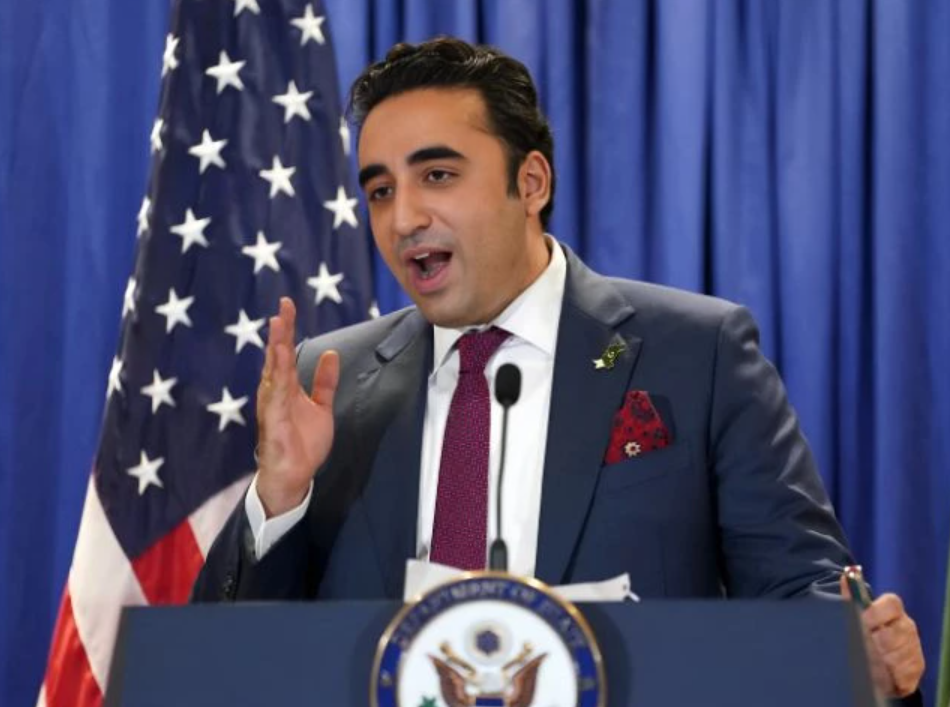
Bilawal Bhutto Zardari Warns Against New Regional Precedent Set by Delhi
WASHINGTON:
Bilawal Bhutto Zardari, leading a senior Pakistani parliamentary delegation, called on the United States to play a proactive role in urging India to engage in a “comprehensive dialogue” with Pakistan, as tensions between the two nuclear-armed neighbors simmer following a recent military standoff.
Speaking during his visit to Washington D.C., the former foreign minister emphasized that, much like the U.S. facilitated the recent ceasefire, it could also help pave the way for renewed bilateral talks.
“Just as the United States and President Trump played a role in facilitating the ceasefire, they should now use their influence to promote a broader and sustained dialogue between Pakistan and India,” Bilawal told AFP. He questioned India’s reluctance, saying, “I don’t quite understand the Indian government’s hesitance.”
The visit to Washington comes weeks after a significant military escalation between India and Pakistan. Both countries have sent high-level delegations to the U.S. capital to articulate their respective positions. While Islamabad has welcomed U.S. involvement, New Delhi remains wary of external mediation, especially on the Kashmir issue.
Bilawal expressed appreciation for the role of the Trump administration in de-escalating recent tensions. “I’ve been critical of U.S. policy in the past, but credit is due where it’s deserved. They helped broker a ceasefire, and that should be acknowledged.”
Highlighting Pakistan’s willingness to address terrorism-related concerns, Bilawal insisted that Kashmir must be part of any substantive dialogue. He warned that India was setting a “dangerous new precedent” by linking every terror incident to military escalation. “This idea that a terror attack automatically justifies going to war creates an unstable new normal for South Asia,” he said.
He added, “The future of 1.7 billion people in our region cannot be dictated by faceless, stateless actors. India’s current approach risks destabilizing the region.”
The two South Asian delegations are not expected to meet during their overlapping visits. India’s team is led by Shashi Tharoor, a senior opposition figure and former UN official, who has also distanced himself from the Modi government’s broader policies while affirming India’s stance on national security.
Tharoor, speaking in Washington, said he received strong support from U.S. lawmakers who acknowledged India’s right to defend itself. He questioned Pakistan’s control over militant groups, referencing the 2008 Mumbai attacks that occurred under former president Asif Ali Zardari’s tenure—Bilawal’s father—despite Zardari’s stated support for peace.
“If they can’t control those who attack us, why should we engage in dialogue?” Tharoor said, alluding to Pakistan’s powerful military and its influence over foreign policy.
Meanwhile, the Pakistani delegation, according to the embassy in Washington, met with U.S. Under Secretary of State for Political Affairs Allison Hooker. Bilawal commended President Trump and Secretary of State Marco Rubio for their role in securing a ceasefire and expressed optimism that it could open a path to sustainable peace in the region.
“The delegation voiced serious concerns over India’s unprovoked aggression, inflammatory rhetoric, and the unlawful suspension of the Indus Waters Treaty,” the embassy said in a statement posted on X (formerly Twitter).