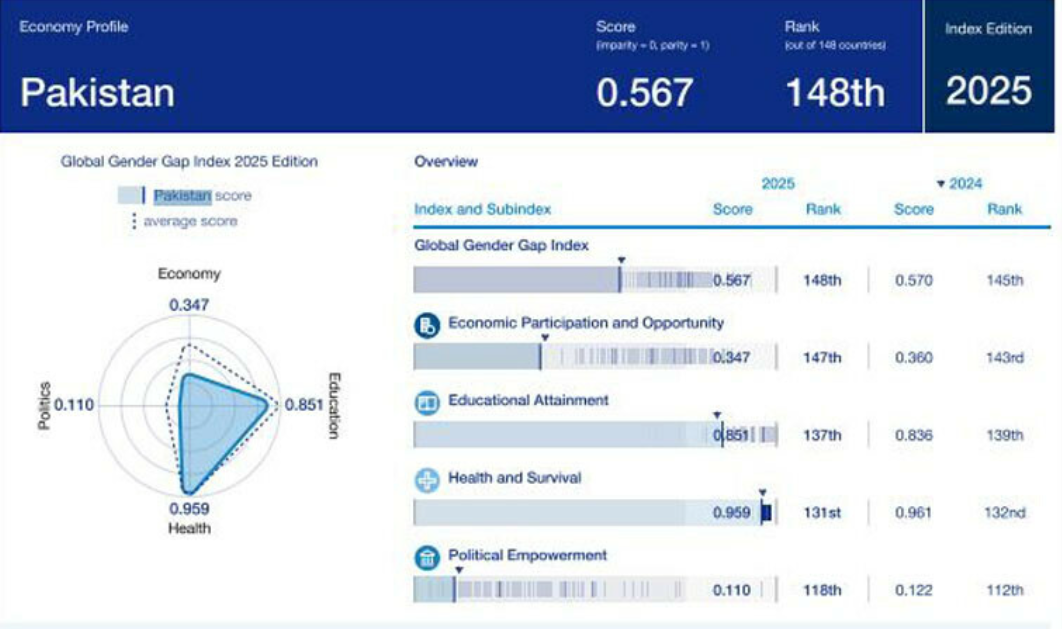

The World Economic Forum’s Global Gender Gap Report 2025 paints a sobering picture for Pakistan, which has ranked at the very bottom—148th out of 148 countries—with a gender parity score of 56.7%. This marks the country’s lowest standing since the report’s inception in 2006, despite having achieved its highest score of 57.7% just two years ago in 2023.
The annual report assesses gender parity across four key areas: economic participation and opportunity, educational attainment, health and survival, and political empowerment. Pakistan’s score declined slightly from last year’s 57%, highlighting stagnation—or even regression—across most metrics.
Notably, Pakistan trails behind countries like Sudan, Chad, Iran, and Guinea, indicating deep-rooted systemic barriers to gender equality. A closer look at the breakdown reveals that Pakistan’s economic parity has suffered, with a 1.3 percentage point drop in economic participation and opportunity. While representation indicators remained stagnant, income disparity and perceived wage inequality both increased.
A modest improvement was recorded in educational attainment, the only sub-index in which Pakistan made progress. The gender parity score in this area rose by 1.5 percentage points to reach 85.1%, largely due to a small increase in female literacy (from 46.5% to 48.5%) and a drop in male tertiary enrolment—raising relative parity but lowering educational reach overall.
On the political front, the situation deteriorated. Although the share of women in parliament rose slightly, overall political parity declined from 12.2% in 2024 to 11% in 2025. Most strikingly, women’s ministerial representation plummeted from 5.9% to zero, placing Pakistan among a small group of countries—including Saudi Arabia and Hungary—with all-male cabinets.
Globally, the gender gap narrowed marginally from 68.4% in 2024 to 68.8% in 2025, but the report estimates that at the current rate of progress, it will take 123 years to reach full gender parity. Iceland remains the global leader with a score of 92.6%, and is the only country to have closed over 90% of its gender gap.
Commenting on the findings, WEF Managing Director Saadia Zahidi emphasized that amid global disruption and transformation, gender parity should be viewed not just as a moral imperative but as an economic strategy. She noted that most economies, including Pakistan, are failing to fully harness their talent pools.
In conclusion, the 2025 report is a stark reminder of the long road ahead for Pakistan in closing its gender gap. Without focused, structural reforms across economic, educational, and political domains, the country risks further entrenchment of inequality in a world that is slowly—albeit unevenly—moving forward.