

By Hira A. Malik
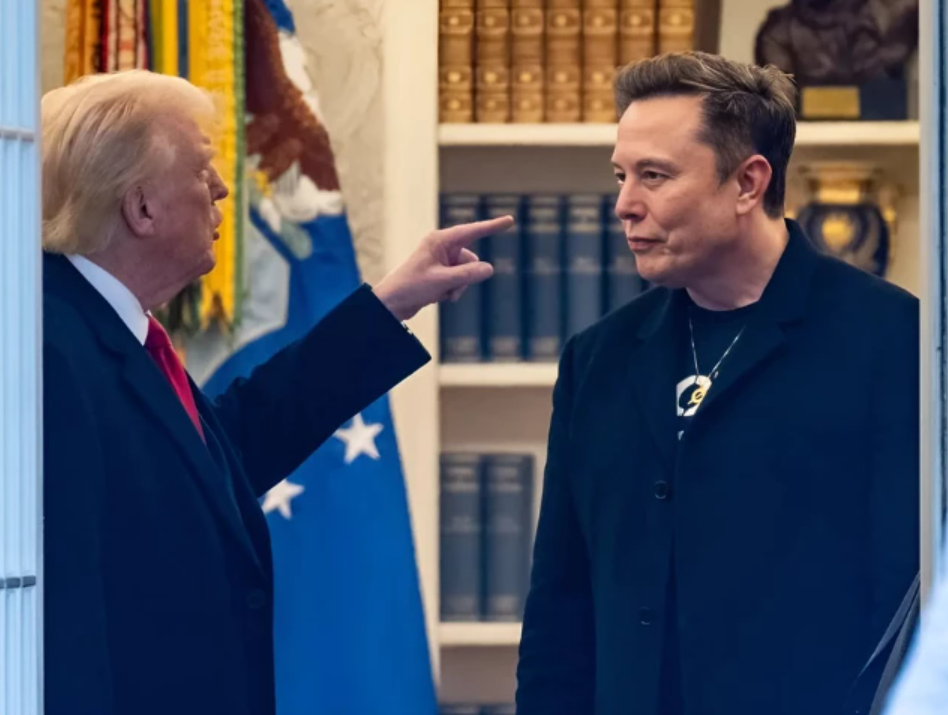
The Trump-Musk feud didn’t implode because of policy disagreements or ideological drift — it collapsed under the weight of two overgrown egos battling for dominance in a political culture where power increasingly hinges not on governance, but on spectacle.
At first, their alliance had all the markings of a tech-political bromance. Musk, the iconoclastic entrepreneur with a fanbase bordering on cultish, and Trump, the ringmaster of the American reality show presidency, seemed destined to storm Washington as a disruptive duo. When Musk stood shoulder-to-shoulder with Trump, donning a MAGA hat and grinning like a co-star, it felt like act one of a made-for-television revolution.
But, like most things built for screens, the partnership was more optics than substance. Musk’s symbolic appointment to the Department of Government Efficiency (DOGE — yes, really) turned Capitol Hill into Comic-Con. There he was, in sneakers and a hoodie, talking about slashing a trillion from the federal budget like it was a Kickstarter pitch, while aides scarfed pizza in the background. Theatrics were the point — policy, a mere subplot.
The real unraveling began when Trump rolled out his flagship legislative project: the “One Big Beautiful Bill.” It promised deep tax cuts and deficit spending, but gutted clean energy support — a slap to Musk’s EV and space empire. Musk called it “a disgusting abomination” on national television. This wasn’t just a policy critique; it was a plot twist in an ongoing drama.
Trump retaliated in true Trumpian style: via Truth Social. He blasted Musk for “ingratitude,” threatened to claw back federal contracts, and all but declared open war on Tesla and SpaceX. The impact was immediate and brutal — Tesla stock nosedived, Musk lost $90 billion in paper wealth, and government deals were suddenly on life support.
At this point, what we were watching wasn’t politics — it was entertainment with consequences. Viewers flipped channels as pundits queued popcorn jokes, while behind the scenes, national defense contracts and clean energy agendas hung in the balance. What masqueraded as a power spat had morphed into institutional sabotage.
Why did it all fall apart? Simple: the game was never about reform, it was about control. Trump demands loyalty, full stop. Musk, a self-mythologizing disruptor, doesn’t do loyalty — he does disruption. Their trajectories were always going to collide. The surprise is that we were ever fooled into believing they could cooperate.
Of course, the media lapped it up. Musk began flirting with the idea of launching his own “America Party,” teasing it on X in a live poll. Trump, ever the enforcer, warned him of “serious consequences” should he drift too far from MAGA. Suddenly, we weren’t watching political discourse — we were watching a spinoff series unfold in real time.
When Musk eventually backpedaled, issuing a half-hearted apology — “I regret some of my posts” — it was too late. The bromance had burned. Markets were rattled, federal relationships damaged, and the DOGE fantasy was all but scrubbed from the national memory. What remained was a bruised public, a shaken investor class, and a gnawing sense that once again, serious governance had been sacrificed for screen time.
But to reduce all this to a simple falling out is to miss the point. What we’re witnessing isn’t an aberration. It’s the new normal: politics as pure performance. Governance by meme. Decision-making driven not by data or deliberation, but by who can dominate the headlines.
Trump pioneered this style in his first term — from North Korea photo ops to dangling policy proposals like cliffhangers. Musk thrives on similar tactics: controversial tweets, chaotic rollouts, and a thirst for digital dominance. Together, they turned government into a content stream.
This feud is less about two powerful men disagreeing, and more about a dangerous transformation in how power is performed — and perceived. When the mechanisms of democracy are reduced to personality clashes, when billionaires shape policy through Twitter (or X, or Truth Social), the citizen becomes a viewer, and governance a ratings war.
And the damage isn’t limited to the characters on stage. NASA, the Pentagon, energy policy — all became collateral in a battle of egos. Analysts have warned of national security implications, investor fears, and a chilling precedent: criticize the king, and risk economic exile.
The real tragedy isn’t that Trump and Musk are at odds. It’s that they were ever allowed to govern via platforms built for provocation. That billions of dollars — and lives — can be impacted by an online spat should alarm every voter, regardless of ideology.
So what now?
Musk may regroup. He may relaunch, rebrand, or recede. His enterprises still touch nearly every corner of American infrastructure — from electric cars to satellite internet. Trump, for his part, has made his point: challenge him publicly, and the consequences will be swift and personal. The message has been received loud and clear across the corporate world.
But the larger question is this: can the public resist the seduction of this kind of politics? The attention economy rewards spectacle. But democracy requires more: deliberation, fact, and institutional respect. If governance is reduced to season arcs and character drama, what’s left for those of us off-stage?
The Trump-Musk saga is over, for now. But the sequel is already being written. Another tycoon, another party, another platform. The script remains unchanged — because we, the audience, keep tuning in.
In the end, the problem isn’t just that our leaders are acting. It’s that we’ve accepted — even demanded — that they do. Until we reclaim our role not as spectators, but as authors of democratic life, the stage will remain crowded, the lights bright, and the institutions increasingly hollow.