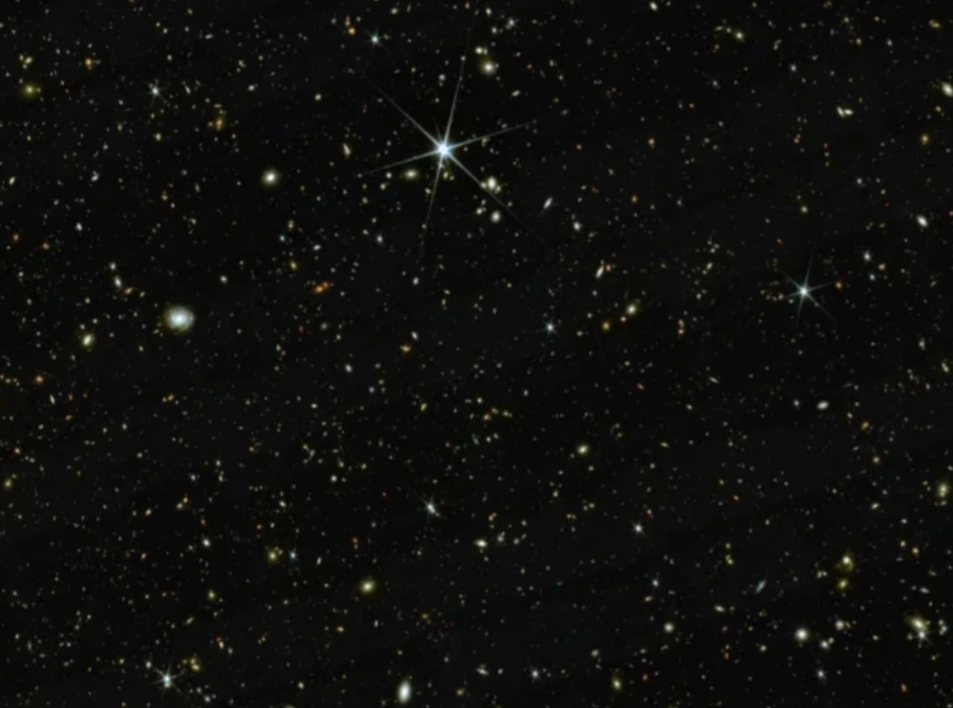

In a monumental leap for astronomy, the James Webb Space Telescope (JWST) has produced the most expansive and detailed map of the distant universe ever created — a panoramic cosmic portrait capturing over 800,000 galaxies and spanning 98% of the universe’s history.
The groundbreaking survey, part of the COSMOS-Web project, covers just 0.54 square degrees of sky — roughly the size of three full moons. Yet, through the lens of JWST’s powerful infrared sensors, this small patch opens an immense window into the early universe, reaching back as far as 300 million years after the Big Bang.
Unlike optical telescopes such as Hubble, JWST specializes in detecting infrared light, which has been stretched over billions of years due to cosmic expansion. This allows it to see ancient galaxies and celestial structures that would otherwise remain invisible.
The findings are nothing short of revolutionary:
- A dramatically higher-than-expected number of early galaxies — in some regions, up to 10 times more than previous estimates.
- Evidence of galaxies and supermassive black holes forming incredibly early in the universe’s timeline.
- Discovery of entirely new galaxy types, reshaping current models of cosmic evolution.
What elevates the significance of COSMOS-Web beyond its scientific insights is its open-data ethos. After two years of data processing, the full dataset has been made public — allowing professional astronomers, students, and citizen scientists alike to engage directly with this unprecedented view of the cosmos.
The long-term implications of the project are profound. This cosmic map not only enhances our understanding of galaxy formation and the large-scale structure of the universe, but also sets the stage for future discoveries — from the behavior of dark matter to the life cycle of early black holes.
As JWST continues to operate, the COSMOS-Web survey will likely remain a cornerstone in the study of the universe’s origins. It’s not just a record-breaking image; it’s a new baseline for cosmic exploration, offering both depth and accessibility in equal measure.