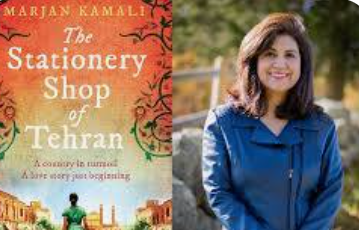

Marjan Kamali’s The Stationery Shop of Tehran is a beautifully crafted, bittersweet novel that lingers in the reader’s heart long after the final page. First published in 2019, this second novel by the Iranian-American author transports us to 1950s Tehran, where personal dreams collide with the forces of political upheaval.
At its core, the novel is a tender love story between Roya, a bookish and idealistic teenager, and Bahman, a passionate young activist who dreams of changing the world. Their romance blossoms within the warm, inviting walls of Mr. Fakhri’s stationery shop — a sanctuary filled with fountain pens, ink bottles, fine paper, and shelves of global literature and Rumi’s poetry. This shop, symbolic of hope and possibility, becomes the backdrop for their young love.
Kamali sets this delicate relationship against the backdrop of a nation on the brink of chaos. Roya’s family, liberal and supportive of Prime Minister Mossadegh’s democratic ideals, welcomes Bahman not only as Roya’s chosen partner but also as an ally in political beliefs. But the optimism of their union is shattered when, on the day of their planned secret wedding — August 19, 1953 — a violent coup d’état changes their lives forever. Bahman disappears without a trace, leaving Roya heartbroken and bewildered.
Kamali masterfully weaves together the personal and the political, immersing readers in the sights, sounds, and tensions of 1950s Iran. The novel brings to life not only a poignant romance but also the hopes and disillusionments of a generation caught in the crossfire of foreign interference and internal strife. The coup against Mossadegh, backed by foreign powers seeking control over Iran’s oil, is rendered with striking detail, showing how geopolitics can devastate private lives.
As Roya emigrates to America to rebuild her life, Kamali sensitively explores themes of displacement, cultural assimilation, and the quiet ache of lost love. We follow Roya’s journey as she adapts to a new world of burgers, handshakes, and unfamiliar customs, while always carrying with her the memories of Bahman and the Tehran she left behind.
The novel’s structure—unfolding through flashbacks, unsent letters, and a moving final reunion decades later—keeps readers engaged, eager to uncover the truth of Bahman’s disappearance. Kamali sustains the suspense skillfully, delivering revelations that are both heartbreaking and cathartic.
Beyond its romantic and political narrative, The Stationery Shop of Tehran is rich in cultural detail. Kamali’s evocative descriptions of Persian cuisine, Nowruz celebrations, and traditional hammam rituals provide a vivid portrait of Iranian life. The novel is also an ode to the resilience of women and the enduring power of love and memory.
In short, The Stationery Shop of Tehran is more than a love story. It is a moving exploration of how history shapes lives, how the past shadows the present, and how the heart endures despite loss. Kamali’s lyrical prose and nuanced characters make this novel a deeply satisfying read for anyone interested in historical fiction, cultural identity, or timeless tales of love and longing.
Final verdict: A poignant, atmospheric novel that beautifully blends romance and political history. Highly recommended for readers who appreciate stories where personal and political destinies are intertwined.