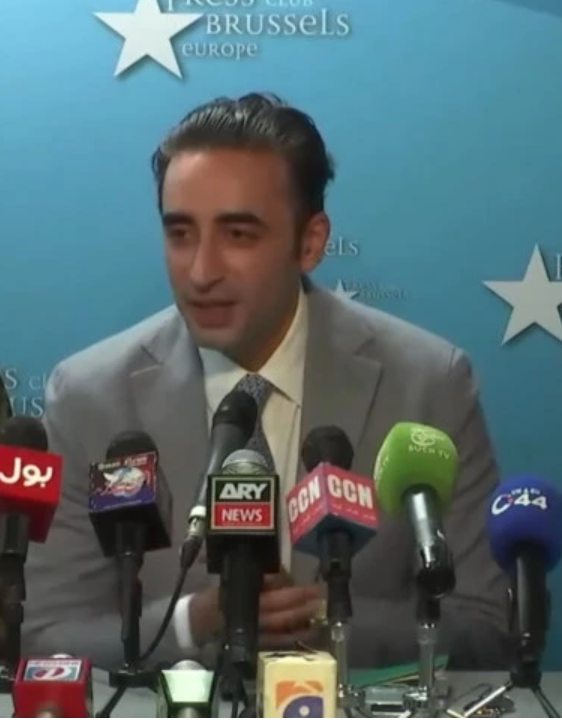
BRUSSELS:
Former foreign minister and Pakistan Peoples Party (PPP) Chairman Bilawal Bhutto Zardari has called on the international community to play a proactive role in resolving longstanding disputes in South Asia and de-escalating growing tensions in the Middle East, warning that the current trajectory of conflict could spiral into a global catastrophe akin to World War III.
Speaking at an international press conference in Brussels on Saturday, where he led a Pakistani parliamentary delegation, Bilawal issued a clarion call for diplomacy over military confrontation, urging world powers to help bring India and Pakistan back to the negotiation table for composite dialogue aimed at resolving key issues including Kashmir, terrorism, and water disputes.
“Military confrontation is not a solution to the Kashmir dispute or terrorism. Dialogue is the only way forward,” Bilawal said. “It is a moral obligation of the international community to encourage diplomacy and push both sides toward peace.”
He criticised India’s refusal to engage in talks, stating that Pakistan has consistently advocated for peaceful resolution of disputes, but New Delhi continues to reject any bilateral dialogue. He especially condemned India’s unilateral actions, including its suspension of the Indus Waters Treaty, calling it a “direct threat to Pakistan’s survival.”
“This is the first water war between two nuclear powers,” he warned. “It’s a war Pakistan cannot afford to ignore — and one the world must take seriously.”
The PPP leader also drew attention to the Kashmir issue, highlighting Pakistan’s calls for impartial investigations into incidents like the Pahalgam attack in Indian Illegally Occupied Jammu and Kashmir (IIOJK) — which he said India refused to accept. He urged the United Nations to place the Kashmir dispute at the top of its agenda, noting its prolonged unresolved status.
“The Jammu and Kashmir dispute must be settled in accordance with UN Security Council resolutions,” Bilawal said, adding that escalating tensions between two nuclear-armed nations pose a grave danger to regional and global stability.
Turning to broader regional concerns, Bilawal issued a strong warning over the escalating military conflict between Iran and Israel, cautioning that it could quickly spiral out of control.
“We certainly do not want a war on our borders,” he said. “Pakistan has condemned the recent strikes on our neighboring country Iran and will continue to advocate for peace — whether with Iran, Afghanistan, or India.”
He stressed that war is becoming the default response to conflict, lamenting what he described as the global community’s failure to resolve disputes diplomatically.
“It’s become far too easy to wage war every month,” Bilawal remarked. “What’s wrong with this generation? We were promised a world of diplomacy and dialogue, not endless wars. My generation is being handed the wreckage of wars started by the older one.”
Calling for an immediate ceasefire in the Iran-Israel conflict, particularly over Israeli military action in Palestine, Bilawal urged international stakeholders to prevent the region from descending into another prolonged crisis.
“We cannot afford for this to become Iraq 2.0 or, worse, World War III,” he warned. “We must not have another petrol war. It serves none of our interests.”
Bilawal was accompanied by several senior members of the Pakistani delegation, including Climate Change Minister Dr Musadik Malik, Senator Sherry Rehman, former foreign minister Hina Rabbani Khar, and former defence minister Khurram Dastgir Khan.
The visit, according to Bilawal, was aimed at conveying Pakistan’s official position on regional tensions and exposing India’s anti-Pakistan agenda to the global audience.
“We are here to represent Pakistan’s stance and remind the world that diplomacy—not confrontation—is the only path to a peaceful and stable future,” he concluded.