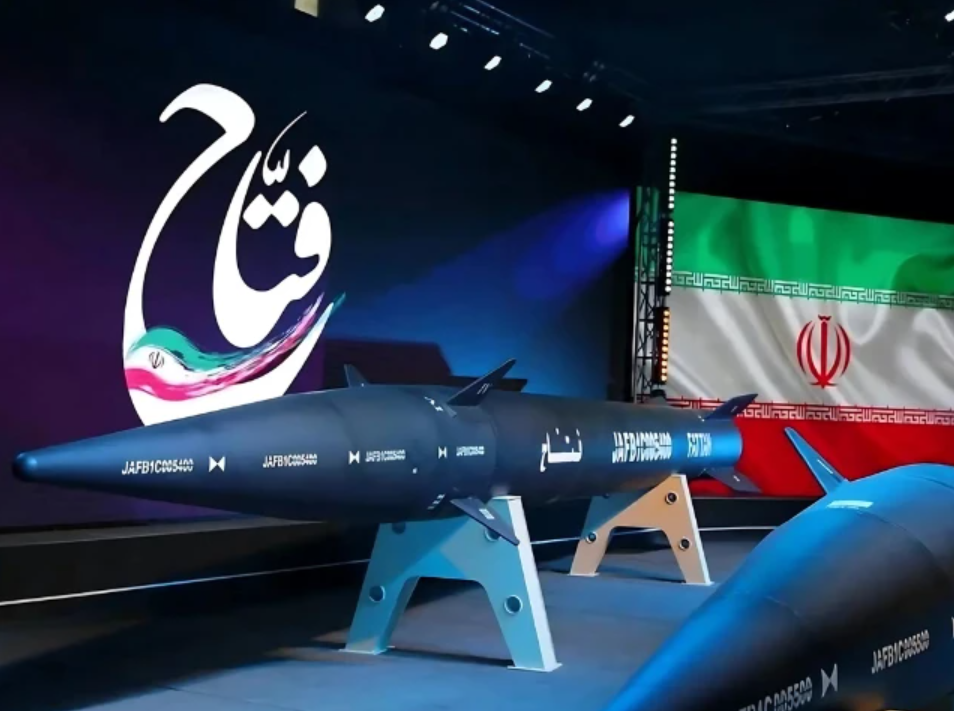

Iran’s reported deployment of its Fattah-1 hypersonic missile has thrust the weapon into the spotlight amid intensifying hostilities with Israel, highlighting a major shift in regional warfare and missile defence dynamics.
What is the Fattah-1?
Unveiled in 2023 and named by Iran’s Supreme Leader Ayatollah Ali Khamenei, the Fattah-1 is Tehran’s first hypersonic missile. Capable of speeds up to Mach 5 (five times the speed of sound), it features a manoeuvrable reentry vehicle that allows it to alter trajectory mid-flight — a key feature designed to complicate interception.
Powered by solid fuel, the Fattah-1 has an estimated range of 1,400 kilometres and uses a single-stage propulsion system. During its public reveal in Tehran, a provocative banner in Hebrew read: “400 seconds to Tel Aviv,” earning the missile its nickname — the “Israel-striker.”
A New Challenge for Israeli Defences
The missile’s advanced capabilities pose a serious challenge to Israel’s missile defence systems, including the Iron Dome and Arrow platforms, which are primarily designed to counter conventional ballistic threats. The Fattah-1’s manoeuvrability and speed shorten the window for interception, putting additional pressure on already stretched Israeli defences.
Fabian Hinz, a weapons expert with the International Institute for Strategic Studies, told CNN that the missile’s reentry design appears tailored for evasion, adding another layer of complexity to missile tracking and neutralisation.
A Turning Point in the Conflict
The Islamic Revolutionary Guard Corps (IRGC) confirmed on June 18 that the Fattah-1 was used in recent strikes — marking its first officially acknowledged use in combat. The timing coincides with reports of dwindling Israeli interceptor stockpiles, raising concerns over the durability of Israel’s missile shield if the conflict escalates further.
Hypersonic missiles like the Fattah-1 are particularly hard to defend against due to their unpredictable flight paths. Unlike traditional ballistic missiles, they can glide and adjust their course in mid-air, severely limiting response time for defence systems.
Strategic Implications
If the Fattah-1 proves reliable in live combat, it may force Israel to reassess its missile defence doctrine and increase investments in next-generation interception technology. It also signals Iran’s readiness to escalate militarily in response to what it calls unprovoked Israeli aggression.
The Fattah-1’s emergence represents more than just a technological milestone — it reflects the broader shifts in the strategic landscape of the Middle East, where hypersonic weapons may increasingly shape future conflicts.
Rising Tensions
As of June 18, over 200 people have been reported dead across both countries, with hundreds more injured in the ongoing Iran-Israel confrontation. Iran has promised further retaliation, while the United States, under President Donald Trump, has demanded Iran’s “unconditional surrender” and is closely watching the situation.
Whether the Fattah-1 becomes a game-changer or just another flashpoint in the escalating crisis remains to be seen — but its arrival has undeniably added a new layer of urgency and complexity to an already volatile conflict.