The recent escalation between nuclear-armed Pakistan and India, which brought the two countries to the brink of a full-scale war, marked a pivotal shift in the nature of their military engagements.
For the first time, Indian Rafale fighter jets, which are of French origin, were shot down during combat operations.
This conflict diverged from past confrontations in several ways. Pakistan did not rely on US-supplied weapons, while India has increasingly turned away from Russian arms in favor of Western-made equipment.
The conflict is not just viewed as a bilateral Pakistan-India issue but as a broader proxy test of Chinese versus Western military technology. This has significant implications for the global arms market and has drawn attention from international powers like France, the US, and NATO-aligned countries.
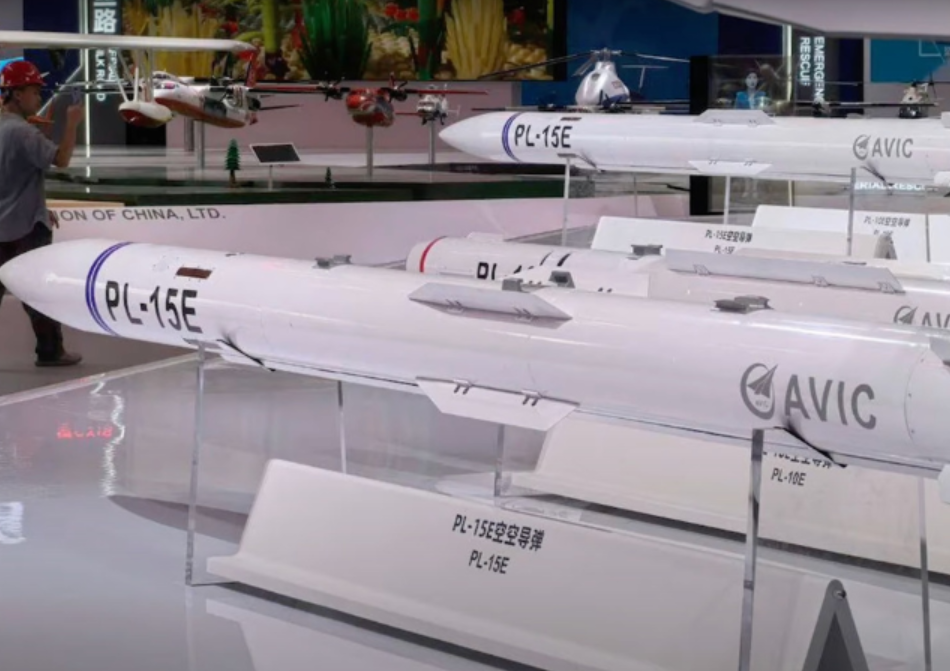
A number of military analysts have pointed to the air engagements, with many speculating that the Chinese-supplied PL-15 air-to-air missile played a crucial role in Pakistan’s success.
Images circulating on social media show the missile’s fuselage, with serial markings and a seeker test port visible. Another image appears to show the missile’s seeker head, featuring an active electronically scanned array (AESA) radar, known for its enhanced tracking capabilities and resistance to jamming.
PL-15 Missile Overview
Developed by China’s Aviation Industry Corporation (AVIC), the PL-15 is a long-range, radar-guided missile designed to engage high-priority airborne targets at ranges over 200 kilometers.
As China’s standard active-radar-guided air-to-air missile, the PL-15 was developed to compete with the US-made AIM-120D Advanced Medium-Range Air-to-Air Missile (AMRAAM).
The export version, the PL-15E, has a reported range of 145 kilometers and is integrated into Pakistan’s JF-17 Block III and J-10CE fighter jets. The domestic version used by China’s military has an impressive range of between 300 to 500 kilometers.
Combat Use in South Asia
On April 26, the Pakistan Air Force (PAF) released visuals of JF-17s equipped with both PL-15E and PL-10 missiles. Pakistan’s fleet, consisting of an estimated 45-50 JF-17 Block IIIs and 20 J-10CEs, comprises around 70 aircraft capable of deploying the PL-15E.
The missile’s guidance system integrates inertial navigation, Beidou satellite updates, a two-way datalink, and AESA radar terminal homing. It features a dual-pulse solid rocket motor and can reach speeds of over Mach 5. The warhead typically weighs between 20 and 25 kilograms and is high-explosive fragmentation.
While Pakistan officially confirmed the use of Chinese-made J-10C fighter jets in shooting down Indian Rafales, it did not specify which munitions were used. However, fragments of a PL-15 missile were reportedly recovered near Hoshiarpur in India’s Punjab state, marking the potential first known use of the missile in active combat.
This development follows reports from US officials, who told Reuters that Chinese-made Pakistani fighter aircraft had downed at least two Indian military jets, underscoring a major milestone for Beijing’s advanced fighter systems.
A senior French intelligence official also confirmed to CNN that at least one Indian Rafale jet was downed during the skirmish with the Pakistan Air Force.
The recovery of the missile debris intensifies air defense planning in the region and highlights the evolving arms dynamics in South Asia. While India’s diverse arms procurement contrasts with Pakistan’s increasing reliance on Chinese systems, this shift is becoming more pronounced.
China’s Global Arms Influence
Chinese state media have highlighted the PL-15E’s export readiness and advanced production capabilities. The missile’s appearance in a live conflict provides China with operational feedback, which could further solidify its influence in the global arms market. Neither China nor Pakistan has officially commented on the missile’s involvement in the conflict.
The deployment of the PL-15 missile in South Asia represents a direct challenge to Western systems such as the US AIM-120D AMRAAM and the French Meteor missile. While the Meteor is renowned for its sustained propulsion via ramjet and superior no-escape zones, the PL-15’s longer range and advanced AESA guidance give it a strategic advantage in first-launch scenarios, particularly when fired from standoff ranges.