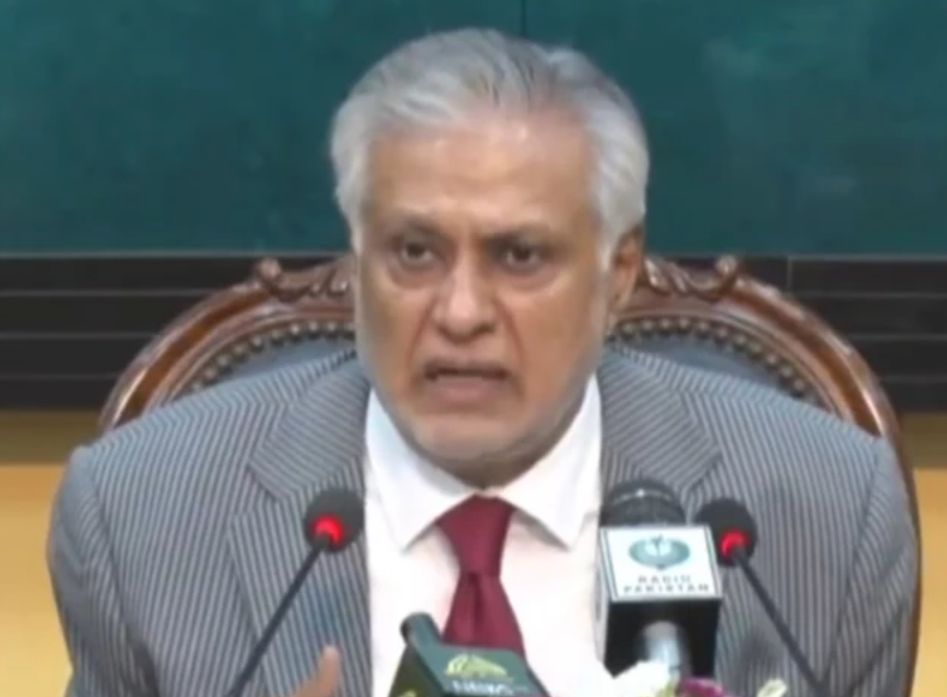
ISLAMABAD: Deputy Prime Minister and Foreign Minister Ishaq Dar announced on Thursday that Pakistan plans to enhance diplomatic relations with the Afghan Taliban government following thorough due diligence and consultations with all relevant stakeholders.
“Before any move, all stakeholders will be consulted. We will carefully weigh the pros and cons,” Dar told reporters when asked about China’s recent statement regarding Pakistan and Afghanistan’s intention to upgrade ties.
China’s foreign ministry had earlier confirmed that Pakistan and Afghanistan expressed readiness to elevate their relationship and agreed in principle to exchange ambassadors. This announcement came after an informal trilateral meeting in Beijing between Chinese Foreign Minister Wang Yi, Pakistan’s Ishaq Dar, and Afghan Interim Foreign Minister Amir Khan Muttaqi.
The meeting was reportedly arranged at short notice, reflecting the shifting geopolitical dynamics. A Pakistani official noted the trilateral talks aimed to send a firm message to India, which has been seeking engagement with the Taliban government to advance its strategic interests.
Dar highlighted that Pakistan, China, and Afghanistan agreed to work together to combat terrorism. He emphasized the commitment to jointly eliminate terror groups operating on their soil, naming organizations such as the East Turkestan Islamic Movement (ETIM), Tehreek-e-Taliban Pakistan (TTP), Baloch Liberation Army (BLA), and the Majeed Brigade.
“Terrorism will not be tolerated in these countries, although achieving this will take time,” Dar said. When questioned about the use of Afghan territory for attacks, he clarified that any assault orchestrated or supervised by the interim Afghan government would be unacceptable. However, he acknowledged the possibility that some groups might operate without Kabul’s knowledge.
Dar described his recent visit to Kabul as productive and mentioned that the Afghan authorities have taken steps to curb terrorist activities, without sharing specific details.
While not ruling out the upgrade of ties with Kabul, Dar stressed that the Afghan government must ensure its soil is not used against Pakistan. “We cannot change our neighbors, but in China, we discussed diplomatic relations, trade, and other issues. We made it clear that Afghan territory must not serve as a base for terrorism targeting Pakistan,” he said.
On the issue of Afghan refugees, Dar announced a new single-document policy allowing refugees to receive a one-year multiple-entry visa to Pakistan, subject to a $100 fee.
Dar called his visit to China “extremely successful,” noting China’s strong support for Pakistan’s sovereignty and territorial integrity. “I was invited by my Chinese counterpart, and during the visit, significant meetings were held. On Wednesday, I took part in the trilateral foreign ministers’ meeting where we discussed Afghan refugees, regional developments, and trade. The agreements from my April 19 visit to Kabul have already been implemented in Pakistan.”
He further revealed discussions about launching Phase II of the China-Pakistan Economic Corridor (CPEC). China expressed readiness to commence this phase with the current Pakistani government.
Dar added that Beijing has agreed to extend CPEC into Afghanistan, including plans for a highway connecting Peshawar to Kabul and a trans-Afghan railway linking Central and South Asia. These projects would be part of the next phase of CPEC, which is a multibillion-dollar expansion of China’s Belt and Road Initiative.