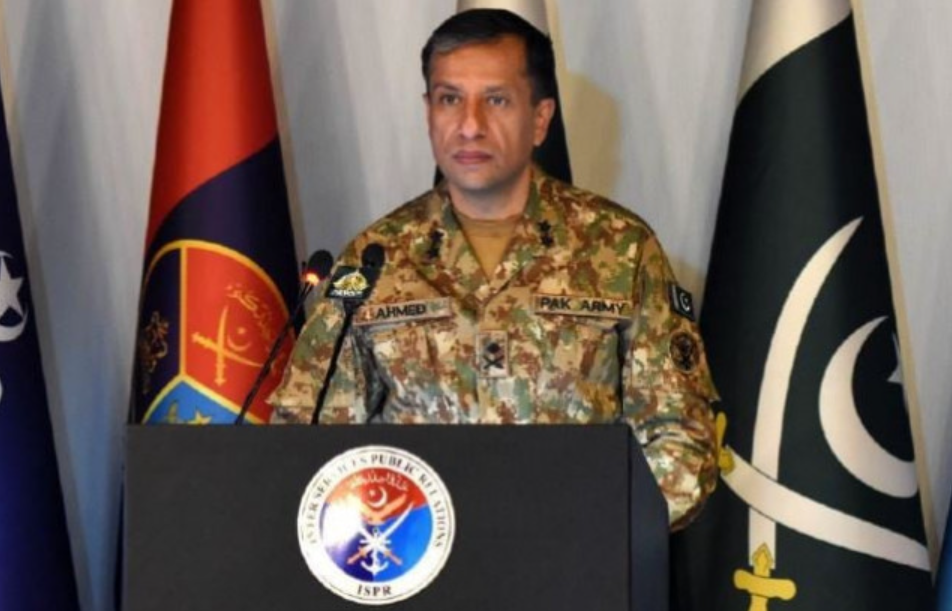
Director General Inter-Services Public Relations (DG ISPR) Lieutenant General Ahmed Sharif, in a special session with students from the Saylani IT programme in Karachi, emphasized the vital role of youth in defending Pakistan on the digital frontlines.
Addressing the gathering on Thursday, the DG ISPR commended the students’ awareness and dedication to the country’s security challenges, describing them as the vanguard of Pakistan’s ongoing information war.
Highlighting the successful execution of Operation Bunyanun Marsoos, he called it a landmark achievement for peace and reiterated Pakistan’s unwavering policy of prioritising peace while maintaining readiness to defend national interests.
During the interactive session, students posed thoughtful questions regarding Pakistan’s internal and external security landscape. General Sharif assured them that the armed forces are a professional and disciplined institution, committed to fulfilling their constitutional responsibilities under the directives of the state.
He stressed that Pakistan would continue playing its role as a stabilising force in the region. The students expressed strong patriotic sentiments, vowing unwavering support for the armed forces and declaring their willingness to stand firm in defence of the nation on all fronts.
The session concluded with enthusiastic appreciation from the participants, who voiced a desire for more such engagements in the future. “Pakistan will always endure,” they declared.
Continued Engagement with Academia
A day earlier, DG ISPR also addressed students at Jinnah University for Women in Karachi, where he highlighted the critical support provided by the youth during the recent confrontation with India under Operation Bunyanun Marsoos. He noted how Pakistani students played a key role in dismantling India’s strategic narratives during the conflict.
Reaffirming Pakistan’s commitment to its territorial integrity, he described Kashmir as the “jugular vein” of Pakistan and highlighted the profound cultural, religious, and historical ties linking the people of Balochistan to the federation. He dismissed any external threat—particularly from a handful of Indian-backed militants—as incapable of undermining Pakistan’s bond with Balochistan.
High-Level Diplomatic Engagement
Meanwhile, in Washington, Field Marshal Syed Asim Munir, Pakistan’s Chief of Army Staff, met U.S. President Donald Trump at the White House. The two leaders discussed expanding bilateral cooperation in trade, energy, artificial intelligence, cryptocurrency, and emerging technologies.
They also reviewed regional security dynamics, including counter-terrorism efforts, the recent ceasefire between India and Pakistan, and growing instability in the Middle East. President Trump was accompanied by Secretary of State Senator Marco Rubio and Special Representative for Middle Eastern Affairs Steve Witkoff, while Field Marshal Munir was joined by Pakistan’s National Security Advisor.