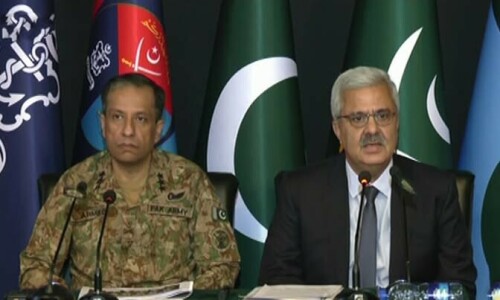
ISLAMABAD: In the wake of a deadly suicide bombing on a school bus in Khuzdar that killed at least eight people, including six children, Pakistan’s top civil and military leadership condemned the act and attributed it to Indian-backed elements. The Interior Secretary and the military’s media wing vowed a decisive response, possibly involving large-scale operations akin to Operation Zarb-e-Azb.
Interior Secretary Captain (retd) Khurram Muhammad Agha said initial investigations pointed to ‘Fitna al-Hindustan’—a term used for Indian-backed proxy groups—as being behind the brutal assault. He condemned the “cowardly” attack and said it marked a shift toward targeting vulnerable civilians, particularly children.
He emphasized that the strike was not just on a school bus, but an attack on education, societal values, and national morale. He added that continuous counterterrorism operations are underway and warned that a major military offensive could be launched if needed.
DG ISPR: India’s State-Sponsored Terrorism Targeting Balochistan
Speaking alongside the Interior Secretary, DG ISPR Lt Gen Ahmed Sharif Chaudhry accused India of funding and orchestrating terrorist attacks across Pakistan for more than two decades, especially in Balochistan. He declared that the perpetrators behind the Khuzdar attack had no connection to humanity, morality, Baloch identity, or Pakistan.
Gen Chaudhry recounted that Pakistan had previously submitted dossiers to the United Nations in 2009 and 2016, providing evidence of Indian involvement in sponsoring terrorism. He also referenced confessions by captured militants, who admitted to receiving financial support from Indian handlers.
Escalation of Terrorist Attacks
He described the Khuzdar attack as part of a wider pattern of violence orchestrated by India:
- April 12 – 12 laborers killed in Nushki
- April 28 – 2 civilians shot in Tump Kech
- February 14 – 10 dead in an IED blast in Harnai
- May 9 – 3 civilians martyred in Lasbela
- Attack on Jaffer Express, targeting off-duty personnel
The ISPR chief noted a worrying trend of targeting women and children, branding it a disturbing escalation. He also presented graphic images and video footage of the Khuzdar victims to underscore the tragedy.
Indian Military Officer Implicated
During the briefing, an audio clip of an alleged Indian Army officer, Major Sandeep, was played. The recording revealed details of how India allegedly routes funds through different channels to finance terrorism in Pakistan.
DG ISPR challenged India’s narrative, questioning how it justifies attacks on mosques and religious schools, and criticized the Indian media for celebrating attacks on Pakistani civilians while deflecting blame.
Advanced Weaponry and External Support
The military spokesperson also displayed images of sophisticated foreign weapons recovered from terrorists, including sniper rifles and night vision equipment, asking rhetorically who was supplying such gear—implying Indian involvement.
He referred to the October 6, 2024, attack on Chinese nationals, which was quickly reported and spun in Indian media, accusing it of amplifying disinformation.
Progress in Balochistan, Ongoing Operations
Lt Gen Chaudhry highlighted that over 200 terrorists have been eliminated in Balochistan this year alone, adding to nearly 250 killed last year. He also stressed the closure of illegal trade routes that finance terrorism, crediting support from the local population.
He showcased development projects in Balochistan—including the Gwadar International Airport, road networks, healthcare, and technical education initiatives—as indicators of progress and prosperity that terrorist groups aim to disrupt.
More than 73,000 Baloch students have been awarded scholarships, showing the government’s commitment to uplifting the region, he added.
National Unity and Strategic Resolve
DG ISPR emphasized Pakistan’s unwavering resolve to protect its sovereignty, saying that India’s proxy warfare aims to destabilize the country but will not succeed. He reaffirmed that Kashmir remains a core dispute and Pakistan will defend its water rights under the Indus Waters Treaty.
Army Leadership Vows Retaliation
This comes a day after the 270th Corps Commanders Conference, where Army Chief Field Marshal Syed Asim Munir and senior military leaders vowed that no force can coerce Pakistan, reiterating the commitment to eliminate foreign-funded terror elements.
The ISPR concluded that Pakistan’s military, government, and people remain united in their fight against terrorism, and that aggression will be met with strength, evidence, and strategic clarity.