• Islamabad slams IWT suspension as a dangerous escalation
• Heated exchanges at UN over targeting of civilians
UNITED NATIONS:
Pakistan has cautioned the United Nations that India’s unilateral suspension of the Indus Waters Treaty (IWT) is a dangerous escalation, violating international law and endangering over 240 million people.
Speaking at a UN meeting on protecting water resources in conflict zones on Friday evening, Pakistan urged the global community to act swiftly to prevent a potential humanitarian crisis and regional destabilisation.
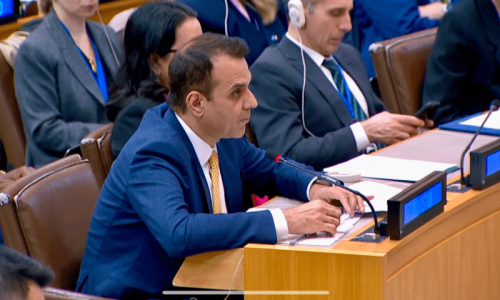
“This is a grave breach of international law, encompassing human rights law, treaty law and customary international law,” said Ambassador Usman Jadoon, Pakistan’s Deputy Permanent Representative to the UN, at the Arria Formula meeting convened by Slovenia.
He strongly condemned India’s decision to suspend the treaty, calling on New Delhi to honour its obligations and to refrain from obstructing or diverting rivers vital to Pakistan’s survival. “We will never accept any such unilateral moves,” Jadoon declared.
He also pointed to provocative statements from Indian leaders, warning that “troubling pronouncements about starving the people of Pakistan reveal a deeply troubling mindset.”
Using the UN platform, Pakistan appealed for a global stance against the weaponisation of water.
Ambassador Jadoon called on the Security Council to stay vigilant and to take preventive steps if necessary.
“The Council has a responsibility to identify and address situations where violations of international law, including IHL (International Humanitarian Law), could threaten peace or cause catastrophic humanitarian fallout,” he said.
Pakistan’s statement underscored three key points: the legal bans on attacks on water infrastructure, the obligations of all conflict parties to respect these laws, and the unacceptability of using water as a weapon. It stressed that denying access to water defies established norms and relevant Security Council resolutions, while using water as a tool of coercion or war is destabilising.
“It is deeply regrettable that one country has chosen to weaponise water instead of pursuing peaceful cooperation,” Jadoon added.
Islamabad’s concerns come amid fears that India is working to bypass the treaty’s established dispute-resolution framework, including the World Bank’s role as a broker. Pakistani officials see this as part of a broader pattern of undermining cooperative mechanisms and applying pressure on Islamabad without using military means.
Ambassador Jadoon reaffirmed Pakistan’s support for global efforts to safeguard water during conflict and called for a “resolute, principled and united” stand against its politicisation or militarisation.
Clash at UN Over Civilian Attacks
In a separate UN meeting, Pakistan and India’s envoys clashed verbally after Pakistani Ambassador Asim Iftikhar Ahmad accused the Indian military of targeting civilians during recent hostilities.
The exchange took place during a Security Council debate on the protection of civilians in conflict.
Indian Ambassador Parvathaneni Harish rejected the Pakistani claims, repeating Delhi’s typical allegations that Islamabad itself promotes terrorism.
Pakistani delegate Saima Saleem fired back, accusing India of relying on “disinformation, deflection and denial.” She said India itself commits acts of terrorism and routinely kills civilians in occupied Jammu and Kashmir and across Pakistan.
“No amount of spin can hide the facts,” she told the Council, pointing out that India recently even stooped to the level of impeding the flow of rivers critical for 240 million Pakistanis.
She noted that Pakistan, along with the international community, had condemned the attack in Pahalgam. “If India truly had nothing to hide, it would have welcomed impartial, credible investigations,” she said, adding that India instead subjects the people of occupied Jammu and Kashmir to state-backed terrorism to crush their freedom struggle.
Recent Attacks and Civilian Losses
Earlier this month, Saleem reminded delegates, India launched unprovoked strikes on civilians in Pakistan, killing 40 people, including seven women and 15 children, and injuring 121 more.
“India has no moral standing to lecture others on the protection of civilians,” she said.
She noted that Pakistan’s counterterrorism efforts and sacrifices are globally acknowledged, whereas India actively funds and supports terror proxies — such as the Tehreek-i-Taliban Pakistan, the Balochistan Liberation Army and its Majeed Brigade — to target Pakistani civilians.
She highlighted the recent attack on a school bus in Khuzdar, which killed and injured many schoolchildren.
“If India genuinely wants peace and good relations, it should stop sponsoring terrorism, end its brutal occupation of Kashmir, uphold its international obligations, and engage in meaningful dialogue to resolve the Jammu and Kashmir dispute in line with UN resolutions and the wishes of the Kashmiri people,” she concluded.