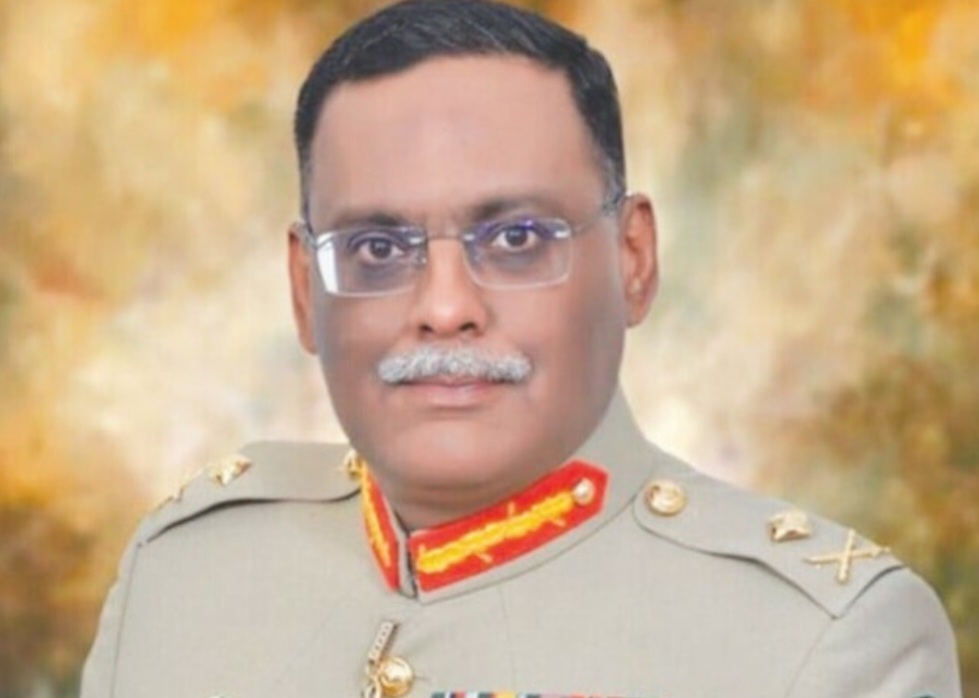
General Sahir Shamshad Mirza, Chairman of the Joint Chiefs of Staff Committee (CJCSC), has emphasised that resolving the Kashmir dispute is crucial for achieving lasting peace and stability in South Asia. Speaking at the 22nd Shangri-La Dialogue 2025 in Singapore, he warned that ongoing tensions with India continue to jeopardise regional security.“The Kashmir dispute, in accordance with UN Security Council resolutions, must be resolved to ensure durable peace,” General Mirza said, calling it the “root cause” of persistent hostility between Islamabad and New Delhi.He underscored the importance of proactive, inclusive dialogue mechanisms—both bilateral and international—to prevent conflicts from escalating.General Mirza also condemned India’s management of shared water resources, accusing New Delhi of weaponising water in violation of international law.“India’s weaponisation of water is illegal and unacceptable,” he declared. “Any attempts to divert or block Pakistan’s waters will be viewed as acts of war, consistent with our National Security Committee’s policy.”He reiterated Pakistan’s readiness for peace with India, provided it is based on mutual respect and dignity.The CJCSC further highlighted the absence of reliable crisis management frameworks, noting that this lack of early action allows tensions to worsen and prevents timely international intervention.“The situation after the Pahalgam incident has endangered regional development,” he cautioned. “We need mutual restraint, respect for red lines, and a balanced approach to establish lasting peace.”Tensions between nuclear-armed Pakistan and India have surged since the deadly April 22 Pahalgam attack in Indian Illegally Occupied Jammu and Kashmir (IIOJK). India blamed Pakistan without evidence, prompting Islamabad to demand an impartial investigation.India responded on April 23 by suspending the 65-year-old Indus Waters Treaty, halting visas for Pakistanis, closing the Wagah-Attari border crossing, ordering the closure of Pakistan’s High Commission in New Delhi, and reducing diplomatic staff.Pakistan, rejecting India’s claims as baseless, retaliated through the National Security Committee (NSC) by suspending trade, closing its airspace to Indian flights, and other countermeasures.India’s subsequent military action was met with a targeted response by Pakistan under Operation Bunyanum Marsoos, which struck Indian air assets and military facilities along the Line of Control and beyond as part of a broader campaign, Marka-e-Haq, between May 7 and May 10.Last month, after four days of clashes, US President Donald Trump announced via social media that India and Pakistan had agreed to a full ceasefire, brokered by Washington. He also offered to mediate a solution to the longstanding Kashmir conflict.General Mirza urged global powers to help restore formal dialogue mechanisms between Pakistan and India, warning that the current diplomatic void increases the risk of miscalculations and conflict escalation.Pakistan’s participation at the Shangri-La Dialogue comes as resource and territorial disputes across South Asia fuel regional instability.The country reiterated its longstanding position on Kashmir and urged international engagement to resolve the conflict through diplomatic channels.Separately, Chief of Army Staff Field Marshal Asim Munir asserted that Pakistan would never accept Indian hegemony in the region, voicing concerns over India’s approach to regional dominance and resource sharing.In a statement released by ISPR, the military’s media wing, the Army Chief reaffirmed Pakistan’s unwavering stance on Indian Illegally Occupied Jammu and Kashmir (IIOJK) and denounced India’s actions regarding shared water resources.