TEHRAN – Iran and Israel traded some of their most intense direct strikes to date on Saturday, dramatically escalating a conflict that has long simmered through proxy battles. As tensions soared, Tehran cancelled a planned round of nuclear negotiations with Washington, declaring it impossible to negotiate under Israeli fire.
The fresh wave of hostilities began after Israeli Prime Minister Benjamin Netanyahu vowed to target “every site of the regime,” while Iranian President Masoud Pezeshkian warned that further aggression would trigger “a more severe and powerful response.” Air raid sirens blared in Israel and Iranian air defences were activated across multiple regions as both nations launched strikes.
Israel’s initial assault, which began early Friday, focused on Iran’s air defences and strategic nuclear and military installations, reportedly killing dozens, including senior IRGC commanders and atomic scientists. Iranian officials said 78 were killed and over 300 injured in the first wave of Israeli strikes.
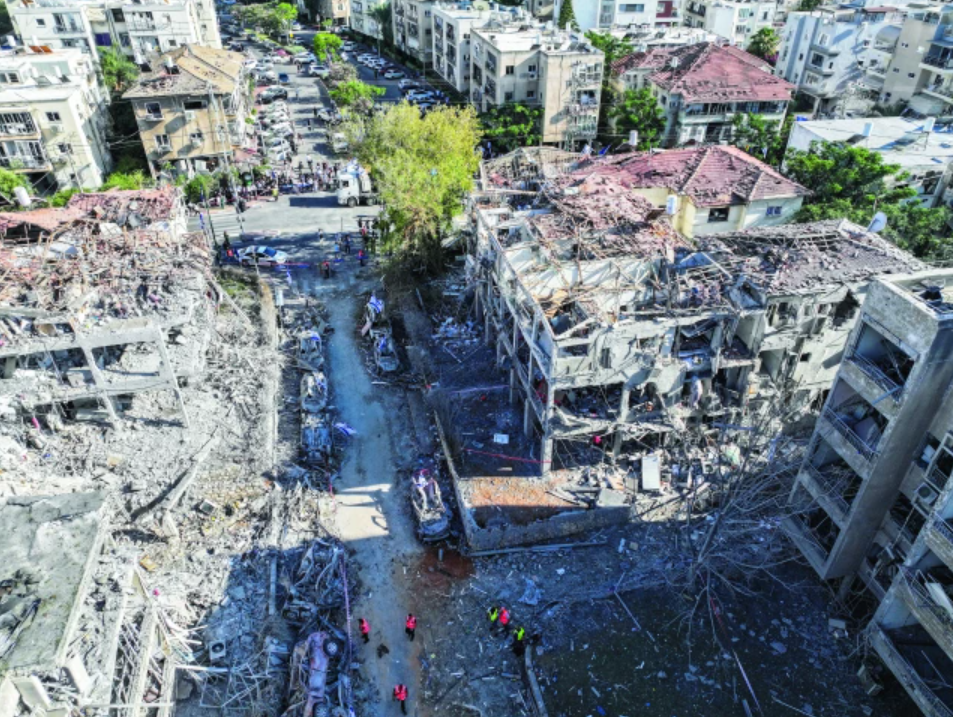
In retaliation, Iran launched ballistic missiles and drones overnight, striking parts of central Israel and causing casualties and widespread damage. Visuals from Tel Aviv and Ramat Gan showed high-rise buildings shattered, vehicles in flames, and debris littering the streets. The Israeli military confirmed three deaths and 76 injuries, while over 20 Iranian commanders were reported killed in subsequent Israeli counterstrikes.
President Pezeshkian accused the United States of duplicity for backing Israel while being engaged in nuclear negotiations with Iran. “The Zionist aggression, carried out with Washington’s support, will be met with a forceful military response,” he said. His office confirmed that the new round of nuclear talks, mediated by Oman and scheduled for Sunday, had been called off.
Iran’s Foreign Minister and lead nuclear negotiator, Abbas Araghchi, stated that Israel’s actions had undermined diplomacy and pushed the region toward “a dangerous cycle of violence.” He reiterated Iran’s denial of Western allegations that it seeks nuclear weapons.
Meanwhile, Netanyahu claimed Israel had dealt a “real blow” to Iran’s nuclear capabilities and stressed he had “clear support” from U.S. President Donald Trump. Trump later confirmed he had spoken with Russian President Vladimir Putin, stating that both leaders agreed on the need to halt the conflict. “This war between Israel and Iran must end,” he wrote on Truth Social.
The conflict has raised international alarms. Turkish President Recep Tayyip Erdogan, in a call with Saudi Crown Prince Mohammed bin Salman, warned that a prolonged war could have devastating consequences across the Middle East.
Among the high-profile Iranian casualties were Major General Mohammad Bagheri, the country’s highest-ranking military officer, and IRGC chief Hossein Salami. Israeli airstrikes also reportedly hit Iran’s Natanz uranium enrichment plant and a major missile facility in Khorramabad, as well as an oil refinery in Kangan, where a massive explosion was reported.
Iranian media said five Revolutionary Guards were killed in Saturday’s strikes alone, and a total of 30 military personnel have died since Friday in one northwestern province. Iran’s Red Crescent reported that an ambulance was struck in Urmia, killing two.
As hostilities expanded, both nations closed their airspace. Jordan, Lebanon, and Syria temporarily grounded flights, though some resumed air operations on Saturday.
The situation remains fluid, with both sides warning of further escalation. Netanyahu called on Iranians to “rise up” against their government, while Tehran urged national unity in the face of foreign aggression.
With direct military confrontation now at its peak, regional stability hangs in the balance and global powers are scrambling to prevent a full-scale war.