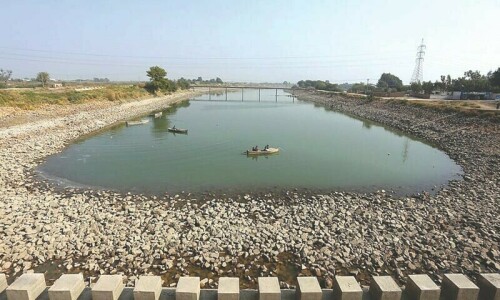
- Kharif Water Shortage Estimate Reduced from 43% to 27% Due to Improved Dam Levels
- Irsa to Consider Increasing Provincial Water Allocations
ISLAMABAD: In a welcome development for the agricultural sector, the projected water shortage for the Kharif season has significantly declined from 43% to 27%, following improved river flows and rising dam levels. This has prompted the Indus River System Authority (Irsa) to increase water allocations to the provinces, raising hopes for better cotton sowing and crop yields.
Irsa is expected to convene its advisory committee soon—its second meeting in a month—to reassess the situation and determine whether further increases in provincial water releases are feasible.
An Irsa official confirmed that this decision came after a meeting of its five-member panel, which noted considerable improvements in both river inflows and water storage.
Earlier, Irsa had resisted pressure—particularly from Sindh—to increase allocations, instead opting for cautious, minimal disbursements, largely intended for drinking water. Consequently, provinces delayed sowing where possible.
Rising Temperatures and Melting Snow
Recent temperature increases in Skardu and surrounding areas, reaching 19-20°C, have led to enhanced snowmelt and improved river flows. However, Irsa cautioned that a coming spell of rain is expected to lower temperatures over the next week, which may temporarily reduce river flows.
To maintain a buffer for peak sowing periods, Irsa initially withheld higher water releases—especially to Sindh. This prudent strategy has now paid off, with the overall water shortage dropping 16 percentage points and live storage reaching around 1.3 million acre-feet (MAF).
The official emphasized the importance of a conservative approach given the unpredictability of climate conditions. It is safer, he noted, to start with a worst-case estimate and gradually increase releases, rather than risk scaling back later at the expense of crops already in the ground.
Updated Provincial Allocations
Irsa has now increased Punjab’s water releases from 41,000 to 64,800 cusecs and Sindh’s from 35,000 to 45,000 cusecs for the next 10 days. Allocations for Khyber Pakhtunkhwa and Balochistan remain unchanged at 1,900 and 500 cusecs respectively, as they are exempt from water cuts.
River inflows have notably improved. At Tarbela Dam, inflows rose to 52,000 cusecs on Sunday, up from 22,000 cusecs at the start of April. Corresponding outflows increased modestly from 15,000 to 20,000 cusecs, building a live storage of 0.435 MAF as water levels climbed from 1,404 to 1,427 feet.
At Mangla Dam, inflows rose from 27,000 to 42,000 cusecs over the same period. Outflows increased from 15,000 to 25,000 cusecs, lifting storage levels from 1,074 to 1,118 feet and improving the water reserve to 0.657 MAF.
Total river inflows at rim stations reached 148,000 cusecs on Sunday, compared to 93,000 cusecs on April 1. Outflows rose to 99,000 cusecs from 73,000 previously. Total live storage stood at 1.293 MAF on Sunday—up from zero at the season’s start.
Earlier Forecasts and Cautious Planning
On March 26, Irsa warned of an unprecedented water shortage, creating uncertainty in planning water distribution for the Kharif season. Consequently, the advisory committee decided to allow only drinking water supplies for April, pending further review.
At that time, there was no usable storage in any of the three major reservoirs, and water shortages at canal headworks reached over 60%.
According to Irsa’s March statement, the decision to approve allocations only for April was based on unclear climate patterns and the Pakistan Meteorological Department’s summer outlook, which predicted below-normal rainfall and above-normal temperatures through June. Winter snowfall in the Indus and Jhelum catchment areas had also been 31% below normal, indicating reduced water availability.
Kharif Crops at Stake
Key Kharif crops, including rice, sugarcane, cotton, maize, and mash, are sown between April and September. The improved water situation has sparked optimism that these crops can be cultivated more effectively this year.