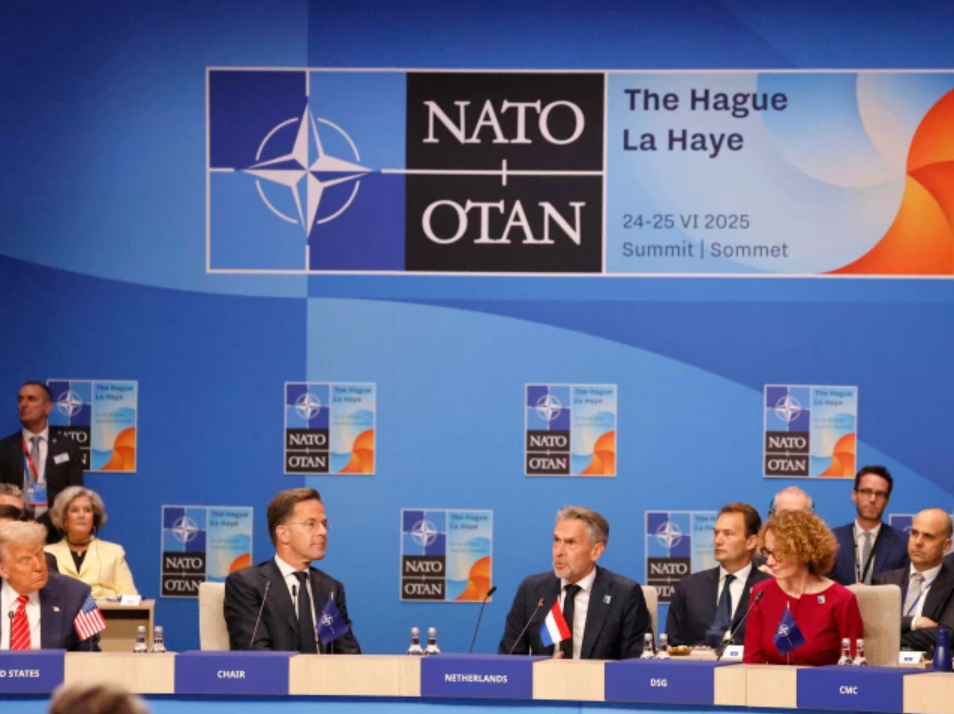
At the NATO summit in The Hague, US President Donald Trump claimed a major foreign policy win as all 32 NATO member states agreed to significantly boost their defence budgets, aligning with his call for military spending to reach five percent of GDP.
The two-day summit concluded with leaders reaffirming NATO’s collective defence commitment — the pledge that an attack on one is an attack on all — offering reassurance to European allies concerned about the Russian threat. The final declaration described this commitment as “ironclad.”
“This is a great victory for everybody,” Trump said ahead of the summit’s main session. “We will be equalised,” he added, praising the new spending agreement.
While Trump celebrated the deal as a personal success, diplomats noted that the agreement gives flexibility to European governments grappling with tight budgets. The compromise plan outlines that by 2035, nations will aim to allocate 3.5 percent of GDP to core defence spending, with an additional 1.5 percent earmarked for broader security needs such as infrastructure.
Behind closed doors, Trump reportedly urged allies to invest their increased budgets in US-made weaponry and emphasised America’s role as NATO’s strongest partner.
European leaders, including Belgian Prime Minister Bart De Wever, called the spending increase “historic” and acknowledged the growing security challenges. “Our long break from history is over,” De Wever remarked, stressing the need for Europe to take greater responsibility for its defence during these difficult times.
The summit, carefully staged to maintain Trump’s engagement, saw him lodged at the royal palace and featured a streamlined agenda. Yet, Trump stirred unease by suggesting NATO’s Article 5 defence clause might be open to interpretation — remarks that were quickly countered by NATO Secretary General Mark Rutte, who asserted Trump’s full commitment to the alliance.
Russia’s invasion of Ukraine was a key backdrop to the summit. The leaders’ statement described Moscow as a “long-term threat to Euro-Atlantic security” — though the language was softer compared to previous years. The new spending targets could also help fund military aid for Ukraine, whose security was described as integral to NATO’s own.
Ukraine’s President Volodymyr Zelensky had a lower profile at this summit, as NATO sought to avoid tensions with Trump following their previous Oval Office clash. Still, Trump called Zelensky a “nice guy” and claimed to be making progress in discussions with Russian President Vladimir Putin about the conflict.
While NATO reiterated that Ukraine’s future membership remains “irreversible,” no specific commitments on Kyiv’s accession were made — reflecting Trump’s position and caution among other leaders. Hungary’s Prime Minister Viktor Orban went further, declaring, “NATO has no business in Ukraine,” underscoring divisions within the alliance.