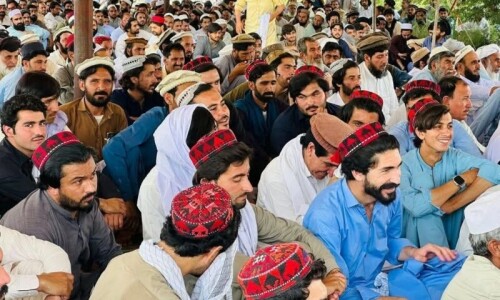
Talks are underway between local authorities and tribal elders in North Waziristan’s Mir Ali tehsil, where residents continue a sit-in protest for the second consecutive day following the deaths of four children in a suspected quadcopter attack.
The alleged strike occurred in Hurmuz village during daylight hours, reportedly killing four children from the same family and injuring five others, including a woman. Sources indicate that both security forces and the banned Tehreek-i-Taliban Pakistan (TTP) have used quadcopters in the region.
District Police Officer Waqar Ahmad told Dawn.com that discussions with local elders are in progress and outcomes are awaited. Prior to the talks, Tehsildar Sher Bahadar said a representative jirga (council of elders) had arrived to coordinate a strategy before entering negotiations. Bahadar is leading the talks on behalf of local authorities.
Despite ongoing investigations at the local level, the federal government has yet to issue an official statement. However, Khyber Pakhtunkhwa Relief Minister Haji Nek Muhammad Dawar condemned the incident and vowed to hold those responsible accountable.
Residents have refused to bury the victims and are continuing their protest at the tehsil headquarters, keeping the bodies in vehicles with air conditioning due to the heat. Protest organizer and local PTI leader Allama Iqbal Dawar stated they want officials to verify that the children were not militants before proceeding with burials.
“We want security officials to come and see for themselves — these children were not terrorists,” Dawar said.
He added that such civilian casualties have occurred before, and although discussions were held with officials after previous incidents, the attacks have not ceased. Dawar emphasized that people are increasingly frustrated and want guarantees that drone strikes in civilian areas will stop.
“The authorities are not engaging with us, and people are losing patience,” he said, speaking before talks were confirmed.
Dawar also criticized the imposition of curfews in the region and claimed that drone strikes rarely hit militant targets, often harming civilians instead.
This isn’t the first incident of its kind. In March, 11 people, including women and children, were reportedly killed in Mardan in what locals described as a drone strike, though officials claimed it was a counter-militancy operation. Similarly, in September last year, an alleged drone strike in the Konrai Raghzai area of Upper South Waziristan left one person dead and three injured. Official confirmation of the incident was never provided.
The Human Rights Commission of Pakistan (HRCP) voiced concern over the latest incident, stating on X that while the source of the strike remains unclear, “the continued use of drones in civilian areas is deeply concerning and constitutes a grave violation of human rights, including the fundamental right to life.” HRCP backed calls for an independent investigation.
In the National Assembly, JUI-F chief Maulana Fazlur Rehman also raised the issue, urging the government to restore the public’s confidence. “If drones are still falling in Waziristan, how can we answer to the people?” he asked. “These are sensitive issues that need serious reconsideration. National unity cannot be preserved without addressing them.”