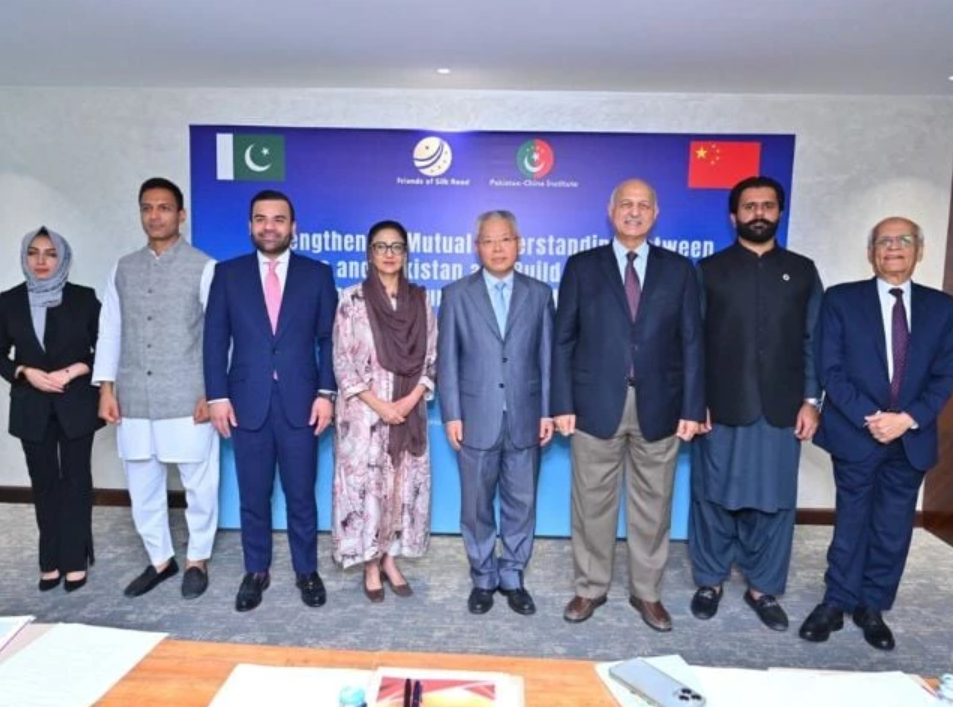
A high-level dialogue focused on strengthening Pakistan-China relations underscored the importance of soft power as a tool to combat disinformation and foster regional cooperation. Organized by the Pakistan-China Institute (PCI) under the Friends of Silk Road initiative, the event brought together diplomats, lawmakers, academics, students, and media professionals from across Pakistan and China.
Held in Islamabad, the dialogue featured a visiting five-member delegation from the International Department of the Communist Party of China (IDCPC), led by IDCPC Spokesperson and Chief of Information Ambassador Hu Zhaoming.
Opening the session, Mustafa Hyder Sayed, PCI Executive Director and moderator, highlighted that the Pakistan-China relationship is built on mutual trust and shared history—not transactional interests. He framed the dialogue as part of PCI’s mission to amplify voices from the Global South amid shifting global dynamics. Criticising U.S. efforts to counter Chinese influence—such as the $325 million-per-year Countering PRC Influence Fund—Sayed called it “a Cold War-era throwback” that undermines development and dialogue in the region.
Delivering the keynote address, Senator Mushahid Hussain Sayed, Chairman of PCI, stressed that the global power structure is shifting from West to East, ushering in what he termed the “Asian Century.” He praised China’s peaceful rise as a force for development across Asia, Africa, and Latin America and expressed gratitude for Beijing’s continued support of Pakistan’s sovereignty, particularly during recent tensions with India.
He warned against framing international politics in terms of a new Cold War or portraying China as a threat. “Security is ensured through cooperation, not through military alliances or disinformation campaigns,” Mushahid said. He also denounced recent Israeli strikes on Iran as blatant violations of international law and the UN Charter.
Ambassador Hu Zhaoming reaffirmed the depth of Pakistan-China relations, describing the two nations as “two sides of the same coin.” He highlighted the transformative impact of the Belt and Road Initiative (BRI), noting that over 150 countries now participate, and credited it with enhancing both China’s inland development and global connectivity. He encouraged the younger generation to continue nurturing this historic partnership.
Representing the Government of Pakistan, Dr. Shezra Mansab Ali Kharal, Minister of State for Climate Change, noted that the world order is undergoing fragmentation. She said China’s vision of multipolarity, equality, and non-intervention—embodied in the BRI—offers an alternative rooted in interdependence and peace.
Former Foreign Secretary Ambassador Aizaz Ahmad Chaudhry described the current era as one of great uncertainty and upheaval, marked by conflicts and the breakdown of global rules. He argued that President Xi Jinping’s “win-win” philosophy and mutual respect could lay the foundation for a more stable international order.
From a legal perspective, Barrister Aqeel Malik, Minister of State for Law and Justice, underscored the importance of security and stability for the success of the China-Pakistan Economic Corridor (CPEC). He advocated for enhanced people-to-people ties through regional-language media—including Balochi broadcasts—and proposed Afghanistan’s inclusion in CPEC as a natural extension of the shared future vision.
The event attracted a diverse group of participants from universities, think tanks, media outlets, and Chinese companies involved in CPEC projects. Discussions included concrete proposals to promote Pakistan-China soft power collaboration, with announcements of upcoming cultural and academic exchanges and conferences in China aimed at furthering this vision.
Overall, the dialogue reaffirmed the strength of the Pakistan-China strategic partnership, emphasized the role of soft power and public diplomacy, and called for unity through cooperation in an increasingly polarized world.