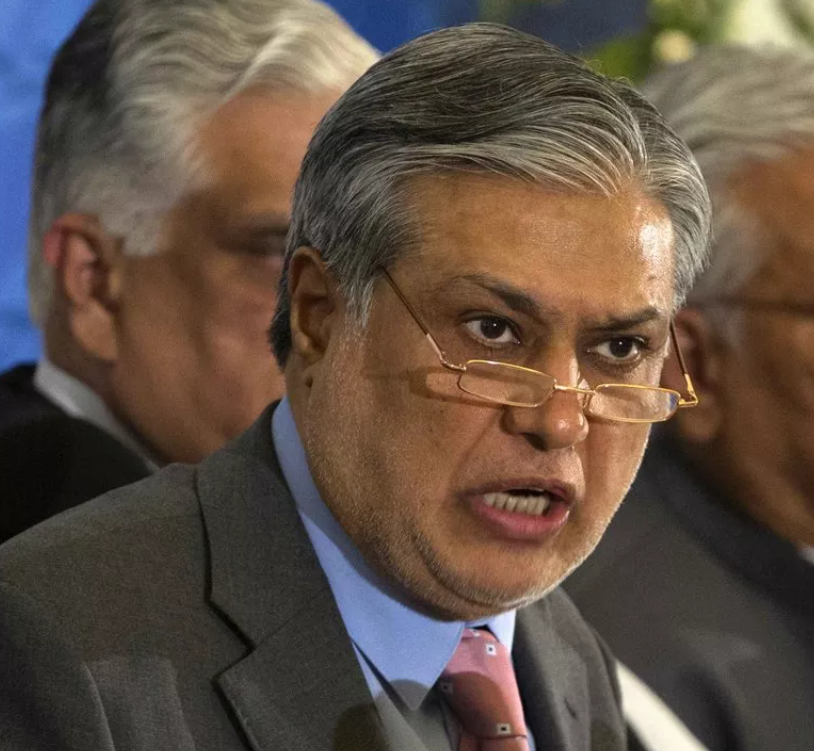
Deputy Prime Minister and Foreign Minister Senator Ishaq Dar has stated that Pakistan never contemplated the use of nuclear weapons during its recent military standoff with India. He emphasized that the country’s response to Indian aggression was measured and strictly defensive in nature.
In his first public remarks since a ceasefire came into effect on Saturday, Dar told CNN that although the situation became highly volatile following India’s airstrikes across the border on May 7, Pakistan had full confidence in its conventional military capabilities.
“We were confident in our ability to respond effectively both in the air and on the ground,” Dar said.
The confrontation, which involved significant casualties and damage to infrastructure in disputed border areas, marked the most serious military escalation between the two nuclear-armed nations since the 1971 war.
Dar characterized India’s actions as a “wishful attempt to assert hegemony” over Kashmir, stating that Pakistan had no choice but to respond to what it viewed as an unprovoked attack.
Despite the intensity of the conflict, a ceasefire was brokered through U.S. diplomatic intervention led by Secretary of State Marco Rubio and Vice President JD Vance. The truce took effect amid continued shelling in parts of Kashmir.
Dar confirmed that no direct communication occurred between Indian and Pakistani officials, with the United States acting as an intermediary.
Indian Prime Minister Narendra Modi, speaking on Monday, described the ceasefire as merely a “pause” in operations and warned of further action if provoked. In response, Dar rejected any narrative suggesting that Pakistan had sought a ceasefire from a position of weakness. “They witnessed the damage we inflicted. The seriousness of our response was clear,” he said.
He reaffirmed that Kashmir remains the core issue between the two countries, pointing out that the territory has been the cause of three wars since 1947. “Kashmir is the root of regional instability. Its future must be determined through the principle of self-determination,” Dar stated.
India has accused Pakistan of supporting militant groups operating in Indian-administered Kashmir—claims Islamabad has repeatedly denied. India’s airstrikes came in response to an April attack in Pahalgam that killed 26 civilians. While India blamed Pakistan-linked militants, it presented no supporting evidence. Dar condemned the killings and reiterated Pakistan’s opposition to terrorism in all its forms.
The foreign minister also raised alarm over India’s reported move to restrict the flow of the Chenab River, warning that such actions could be interpreted as an “act of war” if not reversed. According to Indian media, the government had reduced outflows from the Baglihar Dam, raising concerns over Pakistan’s water supply.
Dar stressed the need for a diplomatic resolution of the water dispute in upcoming talks, cautioning that provocations could endanger the fragile truce. “This ceasefire can only last if such actions are avoided,” he warned.
Despite ongoing tensions, Dar expressed cautious optimism. “We hope to build a future where both nations can coexist with dignity. We still believe reason will prevail,” he said.
India-Pakistan Ceasefire Reached Amid Escalation, Fragile Calm Follows
A full ceasefire between India and Pakistan was declared on May 10 after days of heightened hostilities that pushed both nations to the brink of open warfare. The truce was first announced by U.S. President Donald Trump and later confirmed by leaders from both countries, including Prime Minister Shehbaz Sharif, Foreign Minister Ishaq Dar, Indian External Affairs Minister S. Jaishankar, and U.S. Secretary of State Marco Rubio.
The escalation began with an attack on April 22 in Pahalgam, located in Indian Illegally Occupied Jammu and Kashmir (IIOJK), in which 26 civilians were killed. India accused Pakistan-backed militants of orchestrating the assault, though no evidence was provided. In retaliation, India closed the Wagah border, suspended visas, and revoked the Indus Waters Treaty—moves Pakistan labeled as acts of war.
India intensified its military operations under “Operation Sindoor,” launching missile and drone attacks. In response, Pakistan initiated “Operation Bunyan-un-Marsoos,” during which its military claimed to have downed five Indian fighter jets, including Rafales, and intercepted 77 Israeli-made Harop drones.
Following diplomatic efforts led by Washington, both sides agreed to suspend military activity across land, air, and sea. However, shortly after the truce, new skirmishes were reported along the Line of Control, including explosions in Srinagar and exchanges of gunfire.
Pakistan’s Foreign Office reiterated its commitment to the ceasefire but accused India of violations. Military spokesperson Lt. Gen. Ahmed Sharif Chaudhry emphasized that Pakistan did not seek the truce, asserting that India had requested it following Pakistan’s robust military response. He described war between two nuclear states as “inconceivable” and “an absurdity.”
Chaudhry also dismissed viral rumors claiming that an Indian pilot was in Pakistani custody, calling them baseless. He described Operation Bunyan-un-Marsoos as a unified national response to Indian aggression and affirmed that Pakistan had fulfilled its promise of delivering a decisive and proportionate counterstrike.
On Sunday, cities across Pakistan observed Youm-e-Tashakkur (Day of Thanks) to commemorate what was celebrated as a successful defense of national sovereignty.