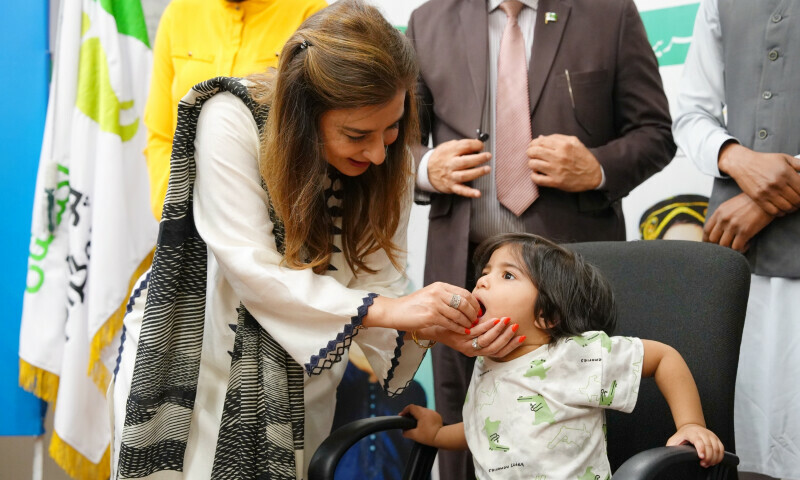
On Sunday, the Pakistan Polio Programme initiated its third nationwide campaign of 2025 to combat polio, held at the National Emergency Operations Centre (NEOC) in Islamabad.
Pakistan remains one of only two countries worldwide—alongside Afghanistan—where polio is still endemic. Despite extensive global efforts to eliminate the disease, challenges such as security concerns, vaccine hesitancy, and misinformation have hindered progress.
Earlier this week, two new polio cases were identified in the districts of Lakki Marwat and Bannu in Khyber Pakhtunkhwa, bringing the total number of cases this year to ten.
A statement from the NEOC confirmed that the third National Immunisation Days (NIDs) campaign was officially launched with the participation of Prime Minister’s Focal Person for Polio Eradication, Ayesha Raza Farooq, along with key members of the polio programme and partner organisations.
To mark the occasion, Farooq administered oral polio vaccines and Vitamin A drops to children under five years old, reaffirming the government’s firm commitment to eradicate polio from all parts of the country.
Scheduled to begin on May 26 and run for one week, the campaign aims to vaccinate over 45 million children under five. The NEOC described the drive as a vital step in Pakistan’s final effort to interrupt polio virus transmission and achieve eradication by the end of 2025.
“Eradicating polio is not only a health objective but also a national priority and a source of great pride for Pakistan,” Farooq said.
She emphasized that this third campaign represents a crucial phase within the “2-4-6 roadmap,” a series of consecutive immunization rounds from September 2024 to May 2025 designed to close immunity gaps and stop virus circulation ahead of the high transmission season.
Farooq acknowledged ongoing challenges in key hotspots such as Karachi, South Khyber Pakhtunkhwa, and the Quetta Block, while highlighting positive progress in reaching underserved communities.
She also expressed deep gratitude to the 400,000 frontline workers—225,000 of whom are women vaccinators—who are driving the campaign, and recognized the vital support provided by civil and military law enforcement to ensure safe access to children.
Despite significant progress, wild poliovirus remains a threat. So far this year, Pakistan has reported 10 cases, and environmental surveillance has detected the virus in 272 sewage samples across 68 districts, indicating ongoing transmission.
UNICEF Representative in Pakistan, Abdullah Fadil, who spoke at the launch event as he concluded his tenure, expressed confidence in the programme’s trajectory. He praised the national leadership and Farooq for their unwavering dedication to polio eradication.
“Pakistan is closer than ever to making history. With sustained political commitment, community participation, and coordinated efforts from all partners, a polio-free Pakistan is within reach,” Fadil said.
The public is strongly urged to support vaccination teams and report any missed children through the Sehat Tahaffuz Helpline (1166) or via WhatsApp.
Polio is a paralyzing disease with no cure. Multiple doses of the oral polio vaccine, along with completion of routine immunizations for all children under five, are essential to build strong immunity against the virus.
Earlier this week, Federal Health Minister Syed Mustafa Kamal reiterated Pakistan’s pledge to eradicate polio by the end of 2025 during a meeting with Dr. Chris Elias, President of Global Development at the Gates Foundation.
Kamal attributed recent gains to effective vaccination campaigns and improved community outreach, noting a marked decline in parental refusal of vaccines.
“The battle against polio has demanded tremendous sacrifices from all involved, including law enforcement personnel who have provided invaluable support,” Kamal stated. “We will continue this mission until polio is completely eradicated.”