ISLAMABAD/KAMRA — In the aftermath of a high-stakes military confrontation, Pakistan has extended a conditional offer for peace talks with India, emphasizing the centrality of the Kashmir issue and reaffirming its readiness to defend national sovereignty. Both civilian and military leaderships have reiterated that dialogue, while welcome, must be anchored in justice, mutual respect, and the right to self-determination for Kashmiris.
Speaking in the Senate, Foreign Minister Ishaq Dar confirmed that Pakistan is pursuing a “composite dialogue” with India to resolve all outstanding disputes. He stated that while a ceasefire has been extended until May 18 through military channels, political dialogue remains essential. He emphasized that Pakistan has never accepted India’s 2019 move to revoke the special status of occupied Kashmir and warned that any Indian attempt to unilaterally suspend the Indus Waters Treaty would be treated as an act of war. “The treaty cannot be amended or terminated unilaterally,” he stressed.
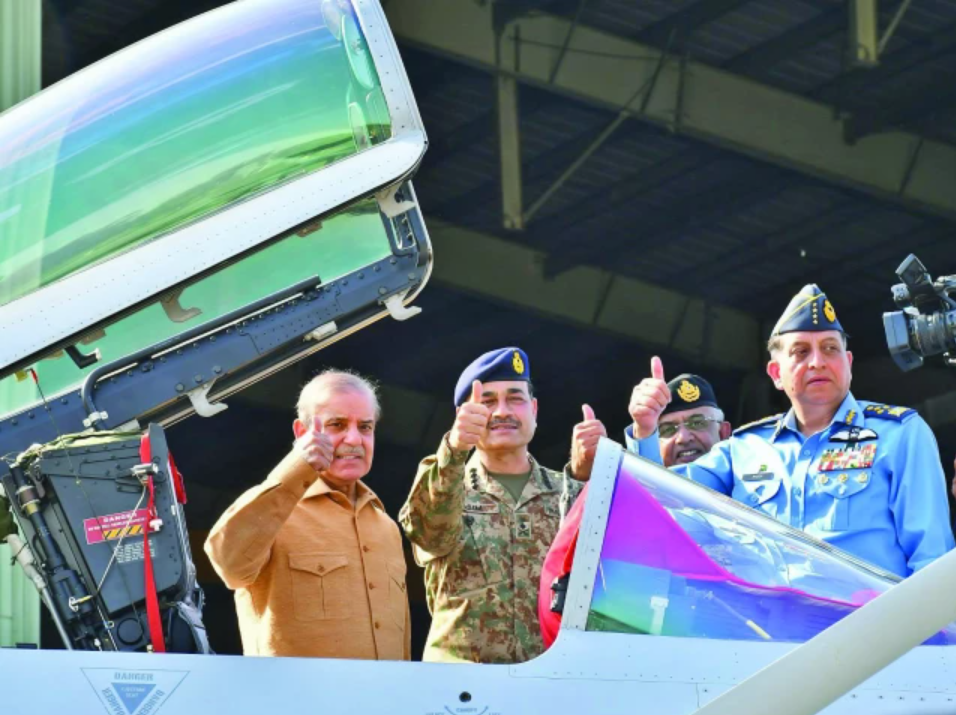
Prime Minister Shehbaz Sharif, in a visit to the Kamra Air Base to commend the Pakistan Air Force (PAF) on its role in the recent conflict, echoed the call for dialogue but insisted that any engagement with India must be centered on the Kashmir issue. “Pakistan is ready for talks for peace, but not at the cost of Kashmir. The people of Kashmir must be granted their UN-mandated right to self-determination,” he stated.
During the conflict, which spanned May 6 to 10, Pakistan claimed it had established air superiority by downing six Indian aircraft, including a Mirage-2000. PM Sharif described this as one of the most significant military triumphs of the 21st century. He lauded the PAF’s operational excellence and noted that the conflict altered the strategic calculus in South Asia. “This magnificent victory has changed the world’s perception of our strength,” he said, adding that Pakistan’s military response was swift, proportional, and precise.
Foreign Minister Dar, while addressing the Senate, clarified that Pakistan had not initiated the ceasefire talks. Rather, the offer came through international intermediaries, including the U.S. Secretary of State. The foreign minister said the world was informed of Pakistan’s position — that it seeks peace with dignity but reserves the right to respond decisively if provoked. He accused India of exploiting the Pahalgam incident, for which it had no proof, to justify aggression and derail the peace process.
A unanimous Senate resolution condemned India for “unprovoked” attacks on civilians and called on the government to internationalize the Kashmir issue, adhere to the Indus Waters Treaty, and defend Pakistan’s water rights as integral to its national security.
In Kamra, PM Sharif emphasized that India’s alleged aggression had been decisively countered, and praised the coordination among Pakistan’s armed forces. He said the Armed Forces’ ability to neutralize a technologically superior enemy showcased the strength of Pakistan’s indigenous capabilities and strategic foresight. The Prime Minister underscored the nation’s unity and resilience, noting that the recent escalation had enhanced global confidence in Pakistan’s resolve.
U.S. President Donald Trump, speaking to American troops during a Gulf visit, stated that the hostilities between Pakistan and India appeared to have “settled,” urging both nations to focus on trade instead of war. The U.S. State Department similarly welcomed the ceasefire and encouraged direct talks, applauding both nations for stepping back from escalation.
Despite renewed calls for diplomacy, both the prime minister and foreign minister underscored that Pakistan’s desire for peace must not be mistaken for weakness. “Our restraint should not be misinterpreted,” PM Sharif warned, adding that Pakistan’s armed forces are fully prepared to respond to any future aggression.
The Prime Minister also accused India of involvement in regional terrorism, including incidents in Balochistan and the historic Samjhauta Express bombing. He reminded the world of India’s role in the creation of Mukti Bahini in East Pakistan and claimed these patterns showed a consistent policy of destabilization.
As both nations navigate a fragile truce, Islamabad maintains that peace is possible — but only if it is anchored in justice for Kashmir and mutual respect between sovereign neighbors.