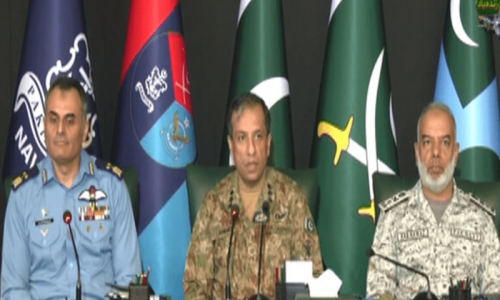
Pakistan’s top military spokesperson has thrown down the gauntlet to India, demanding that New Delhi present credible evidence if it claims Pakistan has launched drone or missile attacks on Indian military targets. “Pakistan has not used drones or rockets. If India insists otherwise, let it bring forward the proof,” said DG ISPR Lt Gen Ahmed Sharif Chaudhry, slamming Indian media for circulating “fabricated stories.”
At a Friday briefing for international media, Lt Gen Chaudhry clarified that Pakistan’s military responses to Indian aggression were confined to Indian military posts along the Line of Control (LoC) that had been firing on civilian areas.
Joining him were Pakistan Air Force’s DG Public Relations, Air Vice Marshal Aurangzeb Ahmed, and Deputy Chief of Naval Staff (Operations), Rear Admiral Raja Rab Nawaz. Together, they updated the media on the situation at the LoC and its broader regional implications, firmly rejecting Indian allegations over the recent Pahalgam attack. They cautioned that India’s actions could jeopardize regional stability.
Lt Gen Chaudhry cast doubt on how Indian authorities managed to pinpoint suspects just ten minutes after the Pahalgam incident. “India has developed a pattern of immediately blaming Pakistan without providing evidence,” he remarked, noting that Pakistan had officially offered an impartial third-party investigation—an offer India has yet to accept.
He suggested that the attack and India’s swift response were intended to distract Pakistan’s security forces from their ongoing counterterrorism efforts. “Pakistan’s government and security institutions are tightening the grip on Indian-backed terrorism every day,” he asserted.
The military spokesperson further revealed that Indian aggression has resulted in the deaths of 33 Pakistani civilians and injuries to 62 others. “We have paid a heavy price,” he said. “Every drop of blood weighs on the conscience of Pakistan’s armed forces, its people, and its state.”
Lt Gen Chaudhry accused India of a long-standing practice of using terrorism for political ends, particularly by targeting innocent Kashmiris and exploiting such incidents to deflect attention from domestic challenges. He also presented video statements from residents in Indian Illegally Occupied Jammu and Kashmir (IIOJK), who questioned their own government’s security failures and labeled the Pahalgam attack as staged.
Additionally, he alleged that India is actively involved in terror financing and cross-border terrorism, not only in Pakistan but also in countries like Canada. He claimed that terrorist training camps operate inside India, and even Indian officials have admitted to backing militants in Pakistan’s Balochistan region.
Highlighting India’s support for groups like Fitna al Khawarij—the official term for the banned Tehreek-i-Taliban Pakistan (TTP)—he called on the international community to hold New Delhi accountable for its actions.
Lt Gen Chaudhry also denounced India’s continued cross-border hostilities, accusing Indian forces of deliberately targeting civilians, including women and children. “India’s baseless aggression must stop,” he warned, emphasizing that Pakistan is fully prepared to defend its sovereignty and national honor.
Pakistan’s military leadership reaffirmed its commitment to peace but issued a stern warning against continued provocations, urging international observers to closely monitor the situation.