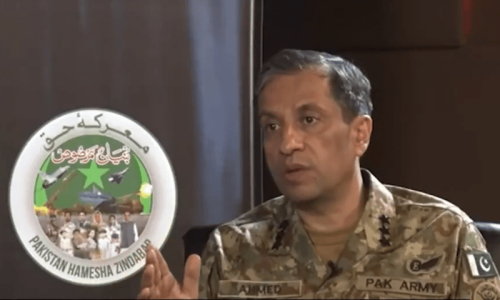
ISLAMABAD: Director General of the Inter-Services Public Relations (ISPR), Lt Gen Ahmed Sharif Chaudhry, emphasized that Pakistan is not a violent nation and reiterated that peace remains the country’s foremost priority, especially in the wake of the recent ceasefire agreement with India.
Speaking to RT Arabic, as reported by PTV News, Lt Gen Chaudhry stated, “We are not a violent nation; we are a serious and responsible one. Our first priority is peace.” He noted that major global powers, such as the United States, recognize the peaceful aspirations of the Pakistani people.
The ceasefire followed heightened military tensions triggered by unsubstantiated accusations from India, which blamed Pakistan for a deadly attack in Pahalgam, located in Indian-occupied Kashmir. Pakistan strongly denied the allegations and called for an independent investigation. As tensions escalated between the two nuclear-armed neighbours, U.S. diplomatic intervention facilitated the ceasefire.
Lt Gen Chaudhry revealed that a ceasefire request was personally conveyed by a spokesperson from India’s defence ministry. While it remains unclear whether the request was made through the United States or directly to Pakistan, the DG ISPR said Pakistan welcomed the proposal in the interest of peace and stability.
He praised the role of Pakistani diplomats, commending their skillful engagement with the international community during the crisis. “With wisdom and maturity, Pakistan responded decisively, compelling the adversary to confront the facts,” he stated.
Recalling the military escalation, Lt Gen Chaudhry said Pakistan retaliated after India conducted deadly airstrikes on May 6–7, targeting areas in Punjab and Azad Kashmir and killing over 30 civilians. In response, Pakistan shot down five Indian fighter jets and intercepted several drones.
The conflict intensified on May 9 when India struck Pakistani airbases and military targets. In response, Pakistan launched missile and air strikes under “Operation Bunyanum Marsoos”, targeting only Indian military installations.
“The Pakistani nation and armed forces stood as a united, impenetrable wall,” said the military spokesperson. Despite India firing additional missiles on May 9–10 in an attempt to intimidate, Lt Gen Chaudhry asserted, “Pakistan and its people do not cower, nor can they be forced to.”
He emphasized that Pakistan’s retaliatory strikes were measured and responsible: “We ensured that no civilian targets were hit. Our response was appropriate, justified, and carefully calibrated.”
India Dismissed Call for Neutral Probe
Lt Gen Chaudhry criticized India’s immediate accusations following the Pahalgam incident, pointing out that Indian officials began blaming Pakistan within minutes, even though their own foreign ministry acknowledged days later that investigations were still ongoing.
“What logic is there in making accusations without evidence?” he questioned. He reiterated Pakistan’s willingness to cooperate in an impartial probe, offering to submit to a neutral investigation if credible evidence was presented.
“India, however, rejected this rational proposal and instead launched missiles at our mosques, killing children, women, and the elderly,” the DG ISPR stated.
He affirmed the armed forces’ commitment to defending the nation’s sovereignty and borders, vowing they would continue to fulfill this responsibility at any cost.
Accusations of Indian-Sponsored Terrorism
Lt Gen Chaudhry also accused India of being a key sponsor of terrorism in the region, specifically within Pakistan. “India is directly supporting terrorism in Pakistan—whether it’s through khawarij elements or insurgent groups operating in Balochistan,” he said, referencing the banned Tehreek-i-Taliban Pakistan (TTP), often described by the state as “Fitna Al Khawarij”.
He added that last month, a terror suspect allegedly trained by Indian operatives was arrested in Jhelum, Punjab, further supporting Islamabad’s claims of Indian involvement in destabilizing activities within Pakistan.