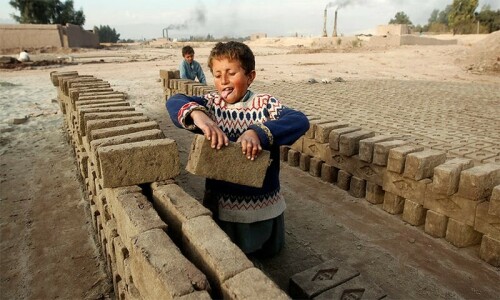

On World Day Against Child Labour 2025, Pakistan’s top leadership—President Asif Ali Zardari and Prime Minister Shehbaz Sharif—issued urgent appeals for unified action to combat the widespread issue of child labour in the country. Their messages underscored the need for a collaborative effort by employers, parents, educators, government institutions, and civil society to eliminate the exploitation of children and safeguard their rights.
According to the Child Rights Movement (CRM), more than 12.5 million children are engaged in child labour in Pakistan, many under hazardous and exploitative conditions. The International Labour Organisation (ILO) reports that one in four households employs children as domestic workers, while in Khyber Pakhtunkhwa alone, 11.1% of the child population is working.
President Zardari emphasized the moral and legal imperative to protect children, calling for the strict enforcement of child labour laws and urging families to prioritize education over short-term financial relief. He highlighted Pakistan’s legislative framework—including the National Commission on Rights of Child Act (2017) and the Juvenile Justice System Act (2018)—as evidence of the country’s commitment to child protection, though he acknowledged that implementation remains a challenge.
The president also stressed the role of the media and philanthropists in raising awareness and supporting vulnerable families. He extended his appeal globally, drawing attention to the plight of children in conflict zones like Gaza, warning that displacement and violence significantly increase the risk of child exploitation.
Prime Minister Shehbaz Sharif echoed these concerns, reiterating that child labour robs children of their fundamental rights, including the right to education and a safe childhood. He acknowledged that while progress has been made, especially through initiatives like the Danish School system for underprivileged children, Pakistan—and the global community—must accelerate efforts.
The PM reaffirmed Pakistan’s alignment with ILO and UNICEF conventions, noting that Article 11 of the Constitution expressly prohibits forced and child labour. He stressed that the 2025 World Day theme, “Progress is clear, but there’s more to do: let’s speed up efforts!”, serves as a powerful reminder that although gains have been achieved, the road ahead remains long.
The upcoming 2025 Global Estimates and Trends Report on Child Labour, to be released by ILO and UNICEF, is expected to provide valuable data to assess current progress and identify areas that need urgent attention.
Pakistan’s last comprehensive Child Labour Survey, conducted in 1996, found that agriculture employed the majority of working children (66%), followed by manufacturing (11%), hospitality (9%), domestic and personal services (8%), transport (4%), and construction (2%). These outdated figures reinforce the urgent need for updated national data to inform evidence-based policies.
In conclusion, the observance of World Day Against Child Labour in Pakistan served as both a call to action and a reflection on the systemic changes needed. While the government’s reaffirmed commitment is encouraging, real change will depend on coordinated, on-the-ground efforts that engage every segment of society—from policy makers to employers, from educators to families. Ending child labour in Pakistan is not just a policy goal—it is a collective moral responsibility.