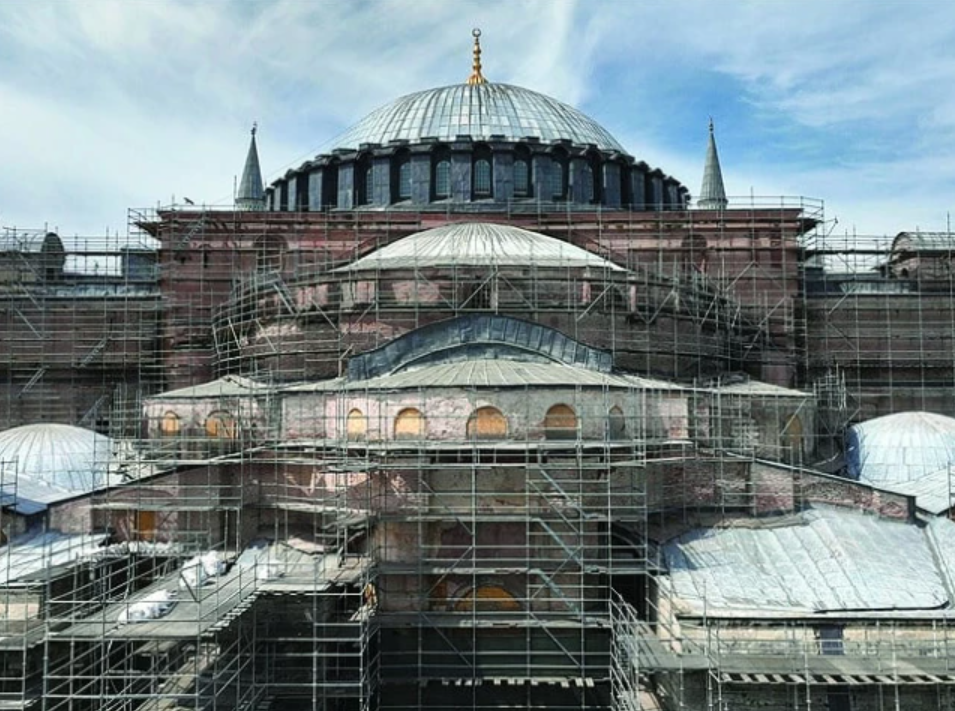

For nearly 1,500 years, Istanbul’s Hagia Sophia has endured the march of time, outlasting empires, earthquakes, and regime changes. Today, it faces a more silent but pressing challenge: structural fatigue amid the looming threat of another major earthquake. In what has become its most comprehensive restoration in over a century, Hagia Sophia is undergoing a methodical healing process, blending ancient architecture with modern science.
Architect Hasan Firat Diker, a member of the Hagia Sophia Scientific Committee, likens the monument to a patient whose ailments become more complex with age. The analogy is fitting. The sixth-century structure, celebrated for its innovative dome and storied transformation from cathedral to mosque to museum and back, now finds itself at the centre of a meticulously planned intervention.
The restoration is not just cosmetic. Engineers and architects are tackling core structural issues, especially the dome’s supporting arches—reconstructed thinner than ideal after collapses in 558, 989, and 1346. One particularly alarming vulnerability is the risk of “hammering,” where different parts of the structure collide during seismic movement. Reinforcing the connection points between the dome and semi-domes is one of several critical tasks designed to increase quake resilience.
Gone are the days of minimal disruption for the sake of tourism. Today’s approach is holistic and informed by decades of data, including lessons from the devastating 1999 earthquake. The project now incorporates earthquake simulations and a disaster response lens at every stage. “We want to protect it, but we don’t want to alienate it,” Diker says—a philosophy that underscores the project’s sensitivity to Hagia Sophia’s identity.
Cultural heritage expert Ilknur Turkoglu echoes these concerns with a broader warning: Istanbul’s rich architectural heritage is acutely vulnerable. While the city doesn’t sit directly atop a fault line, its seismic neighborhood has proven deadly in the past. Yet, Turkoglu points out, there remains no exhaustive inventory of Istanbul’s cultural assets, a glaring oversight in a city that was once the capital of the Roman, Byzantine, and Ottoman empires.
She also stresses that the focus must go beyond buildings to the objects within—museum pieces, artifacts, and display cases that pose hazards if not properly secured. Citing damage patterns from past earthquakes, she warns that even structurally sound walls won’t prevent injury if unsecured contents become projectiles.
Ultimately, this restoration is not just about preserving Hagia Sophia—it’s a reflection of Istanbul’s broader struggle to reconcile its historical legacy with modern-day risks. The ongoing project stands as a benchmark for how ancient structures can be sensitively but seriously prepared for the realities of a seismic future. In treating Hagia Sophia like a living organism, Turkey may just be pioneering a new model for heritage conservation in quake-prone regions.