
Sector braces for $1b import hike, 2 million job losses
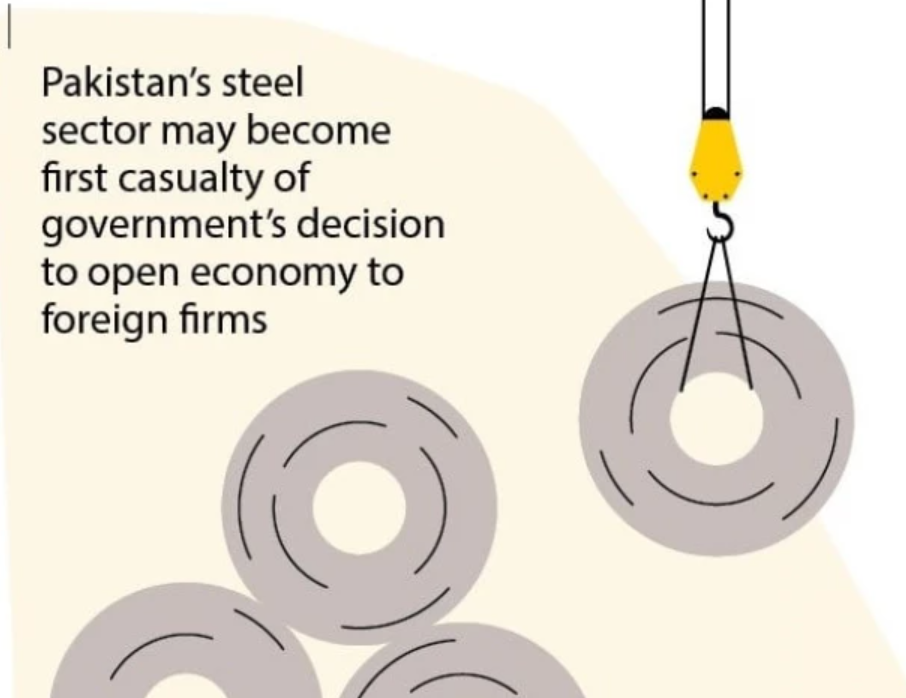
Pakistan’s steel industry has sounded the alarm, warning it could become the first major casualty of the government’s move to slash protection levels and open the market to foreign competition. A recent parliamentary review highlighted flaws in the assumptions driving a 52% reduction in tariff protections.
Abbas Akber Ali, patron-in-chief of the Pakistan Association of Large Steel Producers (PALSP), cautioned on Friday that lowering tariffs would shift the country from steel production to trading in imports. If enacted, the new National Tariff Policy could shut down domestic mills, lead to $1 billion in annual steel imports, and jeopardize around 2 million jobs, he said.
PALSP Chairman Javed Iqbal Malik noted that protection levels for the sector would plummet from the current 53% to just 10% within five years — far below the minimum 38% needed for survival.
Malik said that although Special Assistant to the Prime Minister on Industries Haroon Akhtar Khan heard their concerns, he admitted he could not intervene. A PM-led committee on industry matters has also declined to meet with steel producers.
Commerce Secretary Jawad Paul told lawmakers that under the plan, average tariffs would fall from 20.2% to 9.7% over five years. By FY26, protection would shrink by 22.3%, with customs duties at 11.2%, additional duties at 1.8%, and regulatory duties at 2.7%.
The government based its plan on the World Bank’s GTAP model. However, opposition leader Omar Ayub Khan and other lawmakers criticised the model, calling it static, narrow in scope, and based on unreliable data. The model predicts modest benefits: exports up by 10-14%, imports up by 5-6%, and a 7% reduction in the trade deficit over five years.
PALSP urged the government to delay tariff cuts for at least a year to allow the industry time to stabilise. The group warned that premature cuts could shut local mills, cost $4 billion in foreign exchange, worsen the import bill, and inflate the current account deficit.
Abbas said closures would also leave 4,000 MW of industrial power unused and threaten 2 million jobs. He argued that current tariffs don’t offer protection, but rather offset high state-controlled energy costs.
“We can compete globally if power costs Rs20 per unit instead of Rs40,” he said, noting high rates add Rs50,552 per tonne to production costs.
Pakistan’s steel sector has invested over Rs100 billion in modern plants and does not seek protection, Abbas said. But tariff cuts would flood the market with imports and push the import bill up by at least $1 billion.
Malik urged delaying tariff cuts until power, taxes, and interest rates are regionally competitive. He pointed out that India has raised steel sector protections, and Bangladesh offers 90% protection — twice Pakistan’s current level of 43-57%.
He also highlighted disparities in taxation and mill sizes, noting Bangladesh’s largest mill produces 2.4 million tonnes, while Pakistan’s biggest — at 1.1 million tonnes — is currently shut down.
Abbas stressed that reforms should have paired tariff cuts with incentives for local iron ore mining, as done in India, China, Russia, and Iran, where state-owned miners supply cheaper raw materials to manufacturers. Pakistan’s steel production, at 6 million tonnes, pales in comparison to Iran’s 35 million, India’s 100 million, or China’s 900 million tonnes.