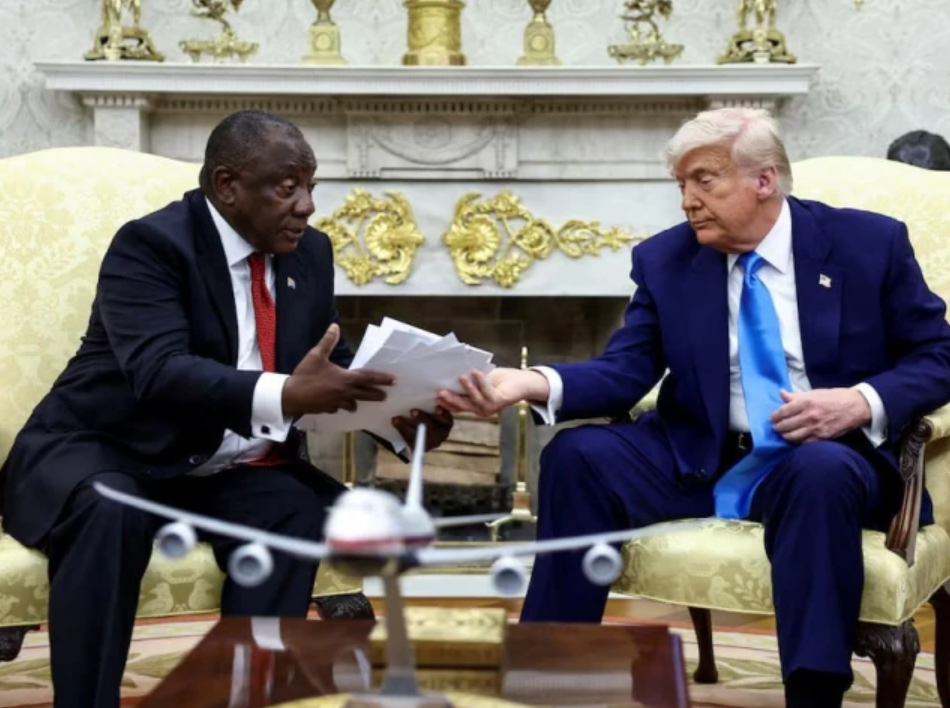
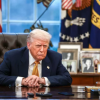
WASHINGTON — A high-stakes meeting between former U.S. President Donald Trump and South African President Cyril Ramaphosa took a contentious turn Wednesday, as Trump confronted his guest with controversial claims of violence and land seizures targeting white South Africans.
The Oval Office meeting, initially scheduled to discuss trade relations and critical mineral cooperation, began cordially with light-hearted comments about golf. South African golfing legends Ernie Els and Retief Goosen joined Ramaphosa’s delegation, helping set a relaxed tone.
However, the atmosphere quickly shifted when Trump presented a video and printed reports alleging systematic violence and land confiscation targeting white citizens in South Africa. Echoing earlier controversial statements, Trump claimed that “people are fleeing South Africa for their own safety. Their land is being confiscated, and in many cases, they’re being killed.”
The South African government has firmly rejected these claims, asserting that crime in the country overwhelmingly affects the Black majority population, and that no racially motivated land seizures or mass killings of white South Africans have occurred.
The allegations refer to South Africa’s land reform law, which permits land expropriation without compensation in specific public interest cases — such as underutilized or fallow land. Authorities emphasize that the legislation is designed to address historical inequalities from the apartheid era and is subject to legal challenge.
During the meeting, Trump played a video featuring white crosses — purported to be graves of white victims — and clips of opposition leaders, including Julius Malema, making provocative statements. Trump even suggested Malema should be arrested.
Throughout the exchange, Ramaphosa remained composed, stating he had not previously seen the video and would investigate its content. When Trump presented printed articles allegedly documenting attacks on white farmers, he repeatedly said “death, death” while turning the pages. Ramaphosa calmly responded that crime was a national issue, with most victims being Black South Africans — a point Trump abruptly interrupted: “The farmers are not Black.”
Ramaphosa diplomatically replied, “These are concerns we are willing to talk to you about,” maintaining a measured tone throughout the tense encounter.
The confrontation also came against a backdrop of strained diplomatic relations. In recent months, Trump has publicly opposed South Africa’s land reform efforts and its International Court of Justice genocide case against Israel. His administration withdrew aid, expelled South Africa’s ambassador, and offered asylum to white Afrikaners, citing alleged racial persecution — claims that Pretoria denies.
Despite the friction, Ramaphosa aimed to refocus the meeting on trade. The U.S. remains South Africa’s second-largest bilateral trade partner, though the relationship faces hurdles, including a possible 30% tariff under Trump’s “Liberation Day” trade framework, currently on hold.
South African billionaire Johann Rupert, part of the visiting delegation, later stepped in to support Ramaphosa. He acknowledged the country’s crime issues but stressed they impact all communities, not just whites. Rupert also praised Elon Musk, a South African-born U.S. tech entrepreneur and Trump ally present at the meeting, suggesting Musk’s Starlink satellite internet service should be rolled out across South African police stations to improve security.