
The UN’s top humanitarian official has accused Israel of intentionally starving Gaza’s civilian population, warning that this could amount to a war crime.
Speaking to the BBC, Tom Fletcher, the UN’s humanitarian chief, said there was no justification for withholding food from a starving population. “It’s defined as a war crime. Of course, these are matters for the courts and ultimately for history to decide,” Fletcher stated.
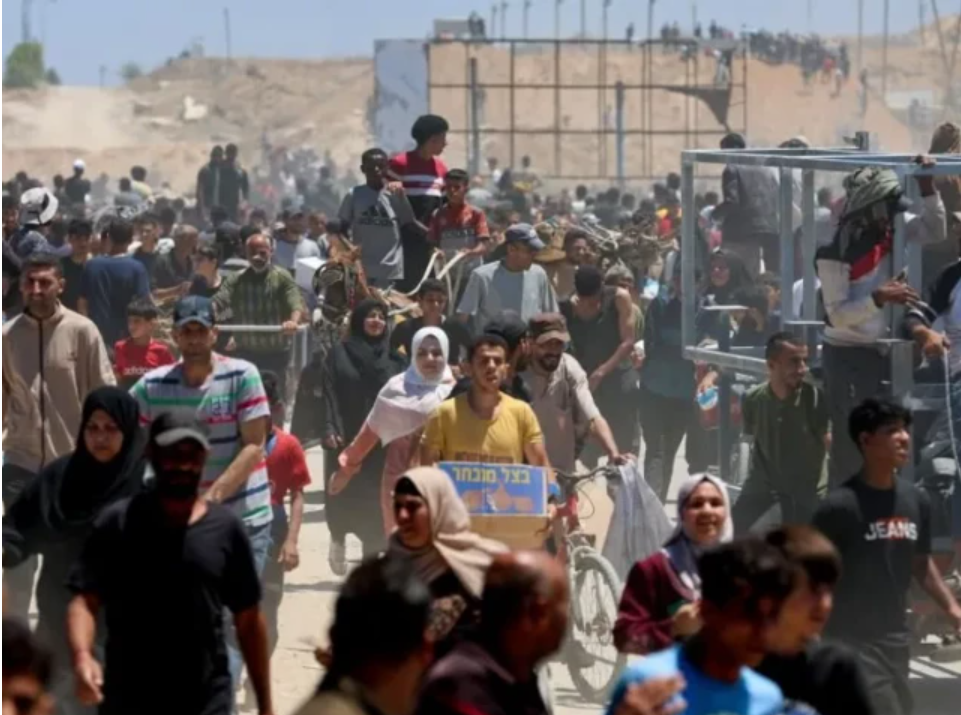
Israel imposed a near-total blockade on Gaza for almost three months, only recently allowing limited aid to enter. Since then, chaotic scenes have unfolded at distribution sites managed by the Gaza Humanitarian Foundation (GHF), a US- and Israeli-backed group not affiliated with the UN.
The UN reported that 47 people were injured earlier this week while trying to access aid at one of these distribution points.
“We’re seeing food stuck at the border, not allowed in while people on the other side are starving,” Fletcher said. “Israeli ministers have openly stated this is to pressure Gaza’s population.”
“We expect governments worldwide to uphold international humanitarian law. The international community has been very clear on that,” he added.
Hamas Rejects US-Brokered Ceasefire Plan, Citing Israeli Aggression
Hamas has dismissed a US-proposed ceasefire plan, saying it would only extend the ongoing Israeli assault and deepen the humanitarian crisis in Gaza.
While the US claims Israel has accepted the deal, Hamas leaders are still reviewing it, according to Al Jazeera.
Hamas officials argue that the proposal lacks the fundamental guarantees Palestinians have long demanded: an end to Israeli military operations, a complete withdrawal of occupation forces, and unrestricted humanitarian access.
“The deal does not address any of our people’s core demands, particularly ending the war,” said Basem Naim, a senior Hamas political official. “Nevertheless, our leadership is carefully studying the offer.”
A response from Hamas is expected by the end of the week, as tensions remain high both on the ground and in diplomatic efforts.
Details of the Plan
A draft of the proposed deal, obtained by Reuters, outlines a 60-day ceasefire during which 28 Israeli hostages—both alive and deceased—would be exchanged for 125 Palestinian prisoners and the remains of 180 Palestinians. Neither side has formally disclosed the full terms.
The plan, mediated by Egypt and Qatar and reportedly guaranteed by President Donald Trump, would also allow international aid to enter Gaza once Hamas signs on.
However, senior Hamas figure Sami Abu Zuhri said the draft does not include any Israeli pledge to end the war or lift the blockade, raising doubts about the offer’s sincerity.
“This is just another attempt to pressure the resistance while civilians in Gaza continue to suffer,” Zuhri told Reuters.
Conflicting Narratives
Earlier this week, Hamas claimed it had reached a preliminary understanding with Trump’s Middle East envoy, Steve Witkoff, that included a permanent ceasefire and the establishment of a neutral governing body in Gaza after the conflict.
Witkoff denied that any such understanding had been reached, calling Hamas’s version “completely unacceptable.” A US official also described Hamas’s claims as “inaccurate and disappointing.”
Israeli officials similarly dismissed Hamas’s narrative, with one unnamed source quoted in Israeli media calling it “psychological warfare.”
Meanwhile, reports indicate Israeli Prime Minister Benjamin Netanyahu is prepared to move forward with the US-backed proposal. Some analysts suggest Netanyahu’s stance is a political maneuver to blame Hamas if talks break down.
“It’s not the first time Netanyahu has made a deal impossible to accept, then blamed Hamas for the collapse,” Israeli analyst Akiva Eldar told Al Jazeera.
Dire Conditions in Gaza
The humanitarian situation in Gaza remains dire. Since Israel resumed its military offensive on March 18, over 4,000 Palestinians have been killed, bringing the death toll in Gaza to more than 54,000, according to Palestinian health authorities.
Despite Israel easing its blockade slightly on May 19 to allow limited aid, UN Secretary-General Antonio Guterres called the relief “a teaspoon of what is needed.”
This week, scenes of desperation played out as thousands of Palestinians crowded limited aid deliveries from the US- and Israeli-backed Gaza Humanitarian Foundation—a controversial effort criticized for lacking transparency and local coordination.
Widespread Devastation and Legal Action
Gaza’s health ministry reported on Sunday that at least 3,785 people have been killed in the enclave since the collapse of the ceasefire on March 18, with the overall death toll nearing 54,000, mostly civilians, according to AFP.
Israel’s military campaign has displaced roughly 90% of Gaza’s estimated 2 million residents, created a severe hunger crisis, and caused widespread destruction.
Since October 2023, Israel’s assault has killed at least 61,000 Palestinians, many of them women and children, according to Al Jazeera.
The International Criminal Court has issued arrest warrants for Israeli Prime Minister Benjamin Netanyahu and his former Defense Minister Yoav Gallant, accusing them of war crimes and crimes against humanity in Gaza.
In addition, Israel faces a genocide case at the International Court of Justice related to its actions in the enclave.