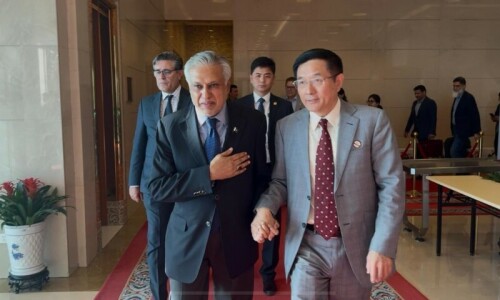
Deputy Prime Minister and Foreign Minister Ishaq Dar arrived in Beijing on Monday for a three-day official visit, at the invitation of Chinese Foreign Minister Wang Yi, state broadcaster Radio Pakistan reported. The visit comes at a time of heightened regional tensions following a recent ceasefire between Pakistan and India.
The trip follows a volatile military standoff triggered by the Pahalgam attack in Indian-occupied Kashmir, which India blamed on Pakistan without presenting evidence. On May 6–7, Indian airstrikes in Punjab and Azad Kashmir reportedly resulted in civilian casualties, prompting Pakistan to shoot down five Indian fighter jets. After a series of drone interceptions and retaliatory strikes on airbases, U.S. diplomatic intervention led to a ceasefire on May 10. While Pakistan has called for dialogue and warned against escalation, India has continued to adopt a hardline stance.
According to the Foreign Office, Dar was received in Beijing by senior Chinese officials and Pakistan’s Ambassador to China, Khalil Hashmi. “Deputy Prime Minister/Foreign Minister, Senator Mohammad Ishaq Dar arrived in Beijing on a three-day official visit from 19–21 May 2025,” the Foreign Office stated in a post on X.
During his visit, Dar will engage in detailed discussions with his Chinese counterpart on the evolving regional dynamics in South Asia and their impact on peace and stability. The two sides will also review the full scope of Pakistan-China bilateral relations and consult on regional and global matters of mutual concern.
The visit is part of ongoing high-level interactions between the two countries, reflecting their shared commitment to strengthening the “All-Weather Strategic Cooperative Partnership,” according to the report.
Afghanistan’s acting Foreign Minister Amir Khan Muttaqi is also expected to be in Beijing and may join discussions focused on promoting regional peace and security.
Ahead of his departure, Dar told the media that China is one of Pakistan’s most significant trading partners and that both countries share a longstanding, close relationship. He also noted that he had two phone conversations with Wang Yi in the past three weeks, during which he was invited to visit China.
Dar stated that his meetings with Chinese leadership would cover a wide range of issues, including bilateral ties, regional affairs, global developments, and recent India-Pakistan tensions. He also mentioned that his recent diplomatic engagements had helped expose India’s baseless accusations against Pakistan, including those concerning attacks on sensitive facilities.
The Foreign Office reiterated that the visit would focus on discussions with Wang Yi regarding South Asia’s regional situation and its broader implications. Both countries would also evaluate the state of their bilateral ties and exchange views on other pressing global issues.
China reaffirmed its support for Pakistan during President Asif Ali Zardari’s meeting with Chinese leaders on May 5, particularly in light of recent hostilities with India. Over the years, China has played a key role in Pakistan’s development through major investments, including the China-Pakistan Economic Corridor (CPEC), often referred to as a “lifeline” for Pakistan’s economy.
China Welcomes Visit, Reaffirms Strong Ties
Chinese Foreign Ministry spokesperson Mao Ning emphasized that Dar’s visit highlights Pakistan’s priority in strengthening bilateral relations. “China and Pakistan are all-weather strategic cooperative partners, maintaining close and high-level exchanges,” she said during a regular press briefing.
She added that China is prepared to work closely with Pakistan to implement shared goals set by both countries’ leaders, enhance strategic communication, and deepen cooperation across various sectors.
Commenting on the recent India-Pakistan situation, Mao Ning reiterated China’s position, stating that Beijing is committed to engaging with both sides and playing a constructive role in facilitating a long-term and comprehensive ceasefire, as well as promoting peace and stability in the region.
“India and Pakistan are both important neighbors to China,” she said, affirming Beijing’s commitment to peaceful and cooperative relations with all neighboring countries.
“We welcome the ceasefire and are ready to support efforts toward making it lasting and comprehensive,” she concluded.