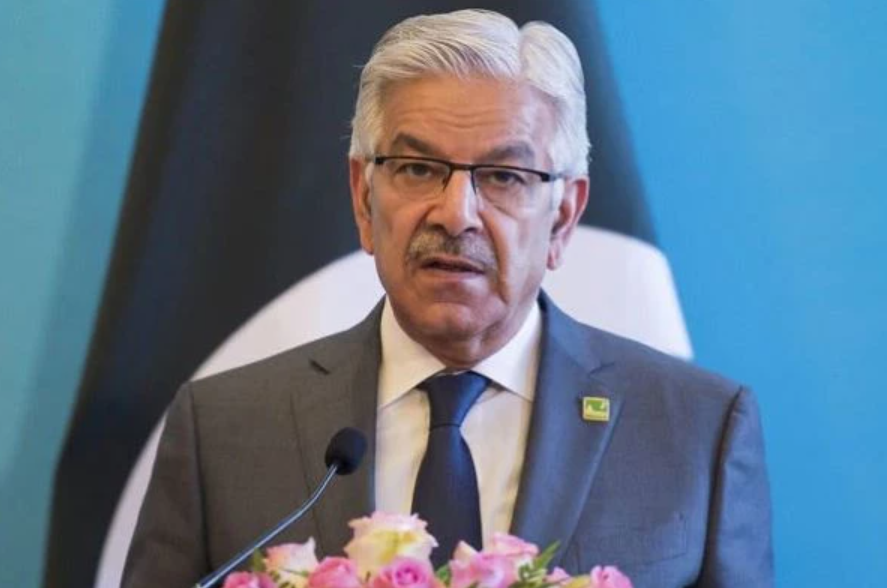
Pakistan will respond decisively if provoked, says defence minister
ISLAMABAD: Defence Minister Khawaja Asif has issued a stern warning regarding the possibility of renewed Indian hostilities, cautioning that Pakistan will deliver a firm and immediate response if provoked.
In an interview with Geo News on Wednesday, Asif said Indian Prime Minister Narendra Modi, facing political isolation and mounting internal pressure, may act impulsively. “If Modi makes a reckless move out of desperation, Pakistan will respond decisively—and such actions will have global repercussions,” he stressed.
Asif suggested that even India’s allies might distance themselves in the event of an escalation. “Pakistan was not under any external pressure to accept a ceasefire,” he clarified. “The United States and other friendly nations supported the decision, which is why we agreed.”
Cyber Warfare and Military Engagement
Reflecting on recent hostilities, Asif emphasized Pakistan’s restraint in the early days of the conflict, hoping India would act sensibly. “Our victory was not just military—it was strategic. For the first time, cyber warfare played a significant role. India’s digital systems were severely disrupted during our cyber operations,” he said.
He also noted a shift in global perception toward Pakistan. “Countries that once dismissed us now regard us with respect. During the recent conflict, we successfully downed five Indian aircraft and one unmanned aerial vehicle (UAV).”
Progress on Kashmir Dialogue
On the long-standing Kashmir dispute, Asif said India appears more open to dialogue than before. “For the first time, New Delhi seems willing to engage on Kashmir. That alone marks a diplomatic win for Pakistan,” he remarked.
Ceasefire After Heightened Conflict
His comments came days after a full ceasefire agreement was reached between India and Pakistan on May 10, following intense military exchanges that had pushed the two nuclear-armed rivals to the edge of war.
The ceasefire announcement was initially made by U.S. President Donald Trump and later affirmed by Pakistan’s Prime Minister Shehbaz Sharif, Deputy PM Ishaq Dar, Indian External Affairs Minister S. Jaishankar, and U.S. Secretary of State Marco Rubio.
Tensions Erupt After Kashmir Attack
Hostilities flared after a deadly April 22 attack in Pahalgam, located in Indian Illegally Occupied Jammu and Kashmir (IIOJK), which claimed the lives of 26 civilians. India accused Pakistan-based actors, but failed to provide evidence—an accusation Islamabad firmly denied.
In response, India escalated tensions by shutting the Wagah border, cancelling visas, and suspending the Indus Waters Treaty—actions Pakistan labeled as “acts of war.”
India then launched Operation Sindoor, involving missile strikes and drone incursions. Pakistan retaliated with Operation Bunyan-un-Marsoos, claiming to have shot down five Indian fighter jets, including Rafales, and intercepted 77 Israeli-manufactured Harop drones.
Though the conflict de-escalated following diplomatic efforts led by the United States, intermittent clashes were reported along the Line of Control just hours after the ceasefire took effect.