
In Pakistan, record-breaking heat is no longer an occasional anomaly — it’s the harsh, unrelenting new normal. From the sun-scorched streets of Jacobabad to Karachi’s sweltering heat islands, the country is living through a brutal transformation of its climate baseline.
A Heatwave That Won’t Quit
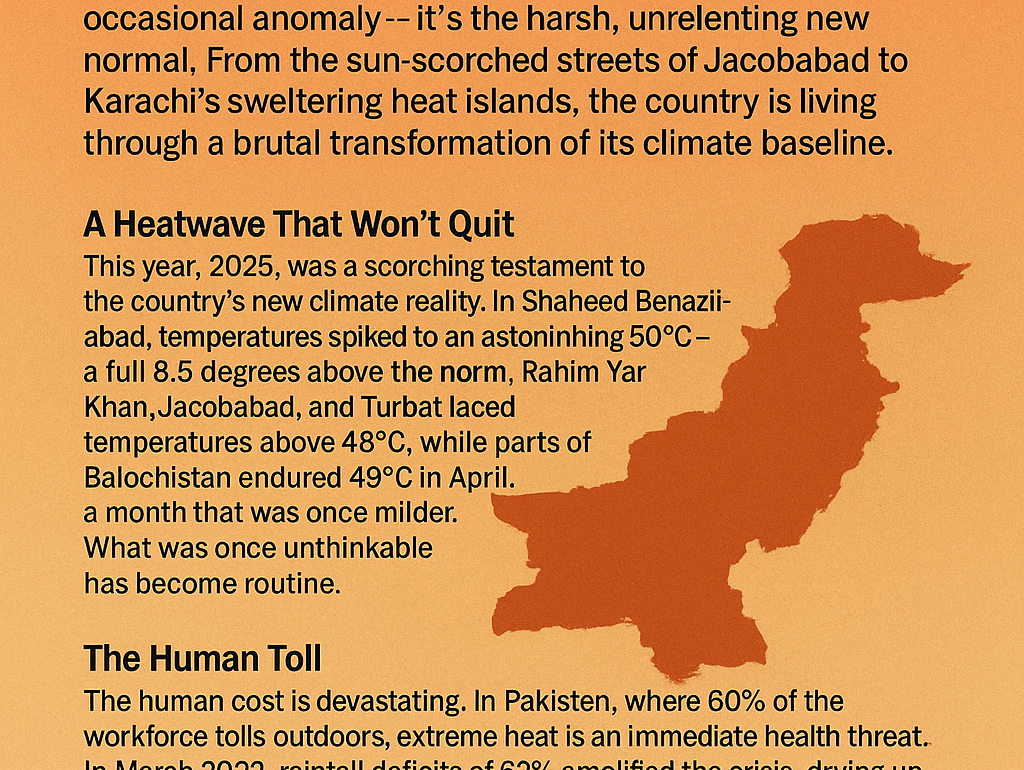
This year, 2025, was a scorching testament to the country’s new climate reality. In Shaheed Benazirabad, temperatures spiked to an astonishing 50°C — a full 8.5 degrees above the norm. Rahim Yar Khan, Jacobabad, and Turbat faced temperatures above 48°C, while parts of Balochistan endured 49°C in April, a month that was once milder. What was once unthinkable has become routine.
Scientific studies confirm that these extremes are no fluke. Research has linked these deadly heatwaves directly to human-caused climate change, revealing that the 2022 South Asian spring heatwave was made about 30 times more likely by greenhouse gas emissions. These findings leave little room for doubt — Pakistan’s heatwaves are no longer just weather events but human-induced disasters.
The Human Toll
The human cost is devastating. In Pakistan, where 60% of the workforce toils outdoors, extreme heat is an immediate health threat. In March 2022, rainfall deficits of 62% amplified the crisis, drying up crops and leaving wheat fields to wither. Urban centres, meanwhile, grappled with surging electricity demand and power outages, as people struggled to stay cool.
The consequences of this relentless heat have been chillingly clear. Karachi’s 2015 heatwave claimed more than 1,200 lives. In 2018, Sindh endured 50°C temperatures that led to dozens of fatalities. Just last year, more than 2,500 heatstroke cases and over 700 estimated deaths across Pakistan painted a grim picture.
A Nation Under Pressure
Pakistan’s average temperatures have already climbed by 1.6°C in the past century — well above the global average of 1.1°C. Extreme heatwaves have increased fivefold in 30 years. And if global warming breaches the 2°C threshold, scientists warn that such heatwaves could batter Pakistan every five years.
Yet Pakistan’s readiness to face these extremes remains alarmingly fragmented. Unlike neighbouring India, which has implemented Heat Action Plans in 130 cities, Pakistan’s climate adaptation strategies are inconsistent, hampered by a staggering $348 billion climate finance gap.
The New Climate Regime
Experts describe this as a “new baseline” — one where searing temperatures stretch beyond the traditional April-May peak, with dangerously high readings as early as January. Nights offer little reprieve as temperatures refuse to dip, while the geographic reach of these heatwaves expands steadily.
But the impacts go beyond meteorology. They magnify existing vulnerabilities — poverty, displacement, informal housing, and fragile healthcare systems. The problem isn’t just the temperature — it’s the way these conditions layer onto fragile systems, deepening the crisis.
Patchy Data, Fragmented Planning
A lack of reliable climate data further hampers adaptation. Inconsistent, low-resolution data limits the ability to anticipate and respond to extreme heat. Without well-monitored datasets and real-time weather information, building targeted public health responses and climate resilience remains a challenge.
Heatwaves on the Move
The geography of risk is shifting, too. Pakistan’s southern plains have long borne the brunt of extreme heat, but even historically cooler areas now report record temperatures. Every region is warming, and no place is immune.
The Existential Warning
The stakes are existential. Pakistan’s climate no longer follows predictable patterns — it’s marked by a relentless “press and pulse” of steady warming punctuated by sudden, devastating shocks.
Yet the country’s response has been reactive, not strategic. There’s no national early warning system to protect the poor, no coordinated health and heat management policy. Instead, heatwaves are treated as episodic disasters — not signals to prepare for a new, more dangerous climate era. And with Pakistan’s average annual temperature already crossing the 1.5°C mark, this future is not a distant possibility but a lived reality.
Urban Greening: A Vital Lifeline
Despite the bleak outlook, solutions exist. Urban greening offers a cost-effective way to cool cities and protect the most vulnerable. Lahore and Islamabad have begun tree-planting initiatives, but most cities fall short. Lahore and Karachi, Pakistan’s economic hubs, have just 5-7% green cover — far below the World Health Organization’s recommended minimum.
Expanding green spaces isn’t just about comfort — it’s about justice. Without social justice in climate action, the cycle of vulnerability deepens. In places like Peshawar and Quetta, where green cover is even scarcer, the challenge is even more urgent.
A Call to Action
Pakistan’s scorching new normal is a stark reminder that climate change is not a distant threat. It’s here, searing its mark on livelihoods, health, and infrastructure. The country’s challenge now is clear: to move beyond survival mode and build a coordinated, equitable climate response that protects its people from a heatwave future that is no longer rare, but routine.