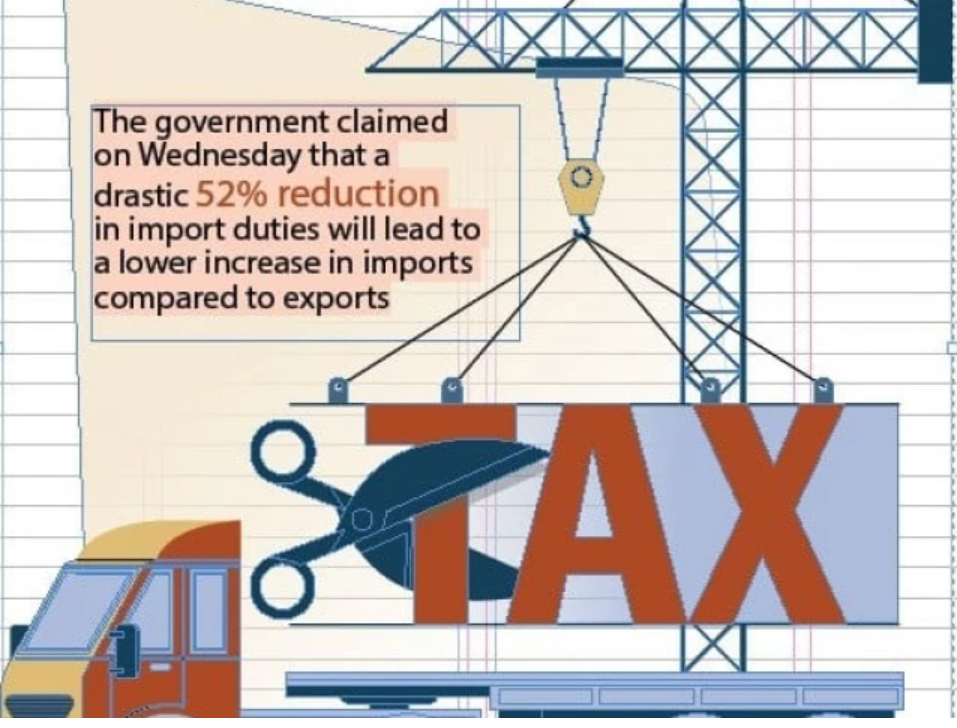

The government announced on Wednesday a significant 52% reduction in average import duties as part of its new National Tariff Policy, claiming it will spur export growth, narrow the trade deficit, and boost revenue by 7–9%. However, these projections—based on the World Bank’s Global Trade Analysis Project (GTAP) model—were met with skepticism during a meeting of the National Assembly Standing Committee on Finance.
Commerce Secretary Jawad Paul, while briefing the committee, said the average applied tariff rate will fall from 20.2% to 9.7% over five years. He projected that exports would grow at twice the pace of imports, with export growth estimated at 10–14% and import growth at 5–6%, citing the GTAP model.
The new tariff framework, described as “Pakistan’s East Asia moment,” aims to shift the economy toward export-led growth and reduce reliance on import protection. However, Finance Minister Muhammad Aurangzeb cautioned that these are projections based on assumptions: “Some may work, and some may not.”
Leader of the Opposition Omar Ayub Khan raised concerns about the broader economic implications, including potential pressure on foreign exchange reserves, inflation, and the trade balance. He questioned how a sharp cut in tariffs could simultaneously boost exports and safeguard macroeconomic stability. The government admitted that the projections were developed by the World Bank, but failed to provide the GTAP model during the session, promising a separate briefing that may not be open to the media.
Critics warned against a “one-size-fits-all” approach by foreign consultants that may not reflect Pakistan’s ground realities. Officials from the finance ministry, FBR, and commerce ministry struggled to clearly outline the impact on inflation, reserves, imports, and fiscal indicators.
FBR Chairman Rashid Langrial acknowledged the adjustment would be challenging, stating, “Trade tariff reform will be painful as inefficient firms will shut down.”
In the first year (FY26), the tariff protection level is expected to decline by 22.3%, with the average custom duty reduced to 11.2%, additional custom duty (ACD) to 1.8%, and regulatory duty (RD) to 2.7%. Despite static revenue loss estimates of Rs500 billion, dynamic projections—accounting for higher compliance, reduced smuggling, and increased transparency—suggest a net revenue gain of 7–9%. For FY25, the FBR estimates a net revenue gain of Rs47 billion, after absorbing a Rs235 billion loss from tariff cuts and benefiting from other reforms such as relaxed age limits for used car imports.
Paul outlined three core objectives of the new tariff policy:
- Promote export-led growth by creating a level playing field.
- Support green and energy-efficient industries.
- Encourage advanced technologies including AI, robotics, nanotech, and electronics.
The policy outlines a phased elimination of additional and regulatory duties within four to five years. The number of tariff slabs will be reduced to four, with a maximum rate of 15% by the fifth year.
For the auto sector, existing duties of 35%—protected under the current Auto Policy—will begin phasing out on July 1, 2026. A new Auto Policy is set to launch the same day, with sweeping duty reductions, revisions to SRO 655 and 656, and elimination of all ACDs and RDs. Quantitative import restrictions on old and used vehicles will also be removed, subject to environmental and quality standards.
Paul added that all items currently receiving concessions under the 5th Schedule will transition to the 1st Schedule, aligning either with Most Favoured Nation (MFN) rates or the nearest existing slab.
In response to concerns, the FBR and commerce ministry assured lawmakers that no new duties would be imposed on agricultural machinery and that current duties in the sector are already on a downward trajectory.
Finance Minister Aurangzeb informed the committee that a monitoring committee under his leadership has been formed to oversee implementation and make policy adjustments where needed. “Lowering tariffs on raw materials is essential—otherwise, industries will collapse,” warned PTI MNA Mubeen Arif Jutt.
Immediate Budget Measures
The Ministry of Commerce has proposed the following tariff reductions in the FY25 budget:
- Elimination of 2% ACD on 2,156 tariff lines with zero custom duty.
- Reduction of 3% custom duty to 0% on 896 tariff lines.
- 11% CD lowered to 10% on 1,023 lines.
- 16% CD reduced to 15% on 486 lines.
- ACD cuts:
- 7% slab → 6%
- 6% slab → 4%
- 4% slab → 2%
- 2% slab → eliminated entirely
PPP MNA Nafisa Shah questioned the rationale behind Pakistan’s unilateral tariff reductions at a time when much of the world is leaning toward protectionism. However, Secretary Paul argued that high tariffs have historically hindered Pakistan’s competitiveness and that alignment with WTO’s MFN regime is necessary for long-term trade sustainability.